Augmented, virtual or mixed reality: choosing the right tool for disaster risk management

Extended Reality (XR) – an umbrella term for Augmented Reality (AR), Virtual Reality (VR), and Mixed Reality (MR) – is emerging as a promising tool to improve how people understand, prepare for, and respond to disasters. These technologies offer new ways to visualize risk, train responders, and support decision-making .
However, a key question remains: which XR technology is most appropriate for different hazards and phases of disaster risk management?
Understanding current trends in XR use
To explore this question, a review of 82 scientific studies on XR applications in disaster contexts was conducted. Noting that most research focuses on earthquake-related hazards, with comparatively less attention given to other risks such as floods, cyclones, or drought.
Overall, each XR technology has distinct strengths, which influence how it can support different phases of disaster risk management. More specifically, the analysis shows three clear trends.
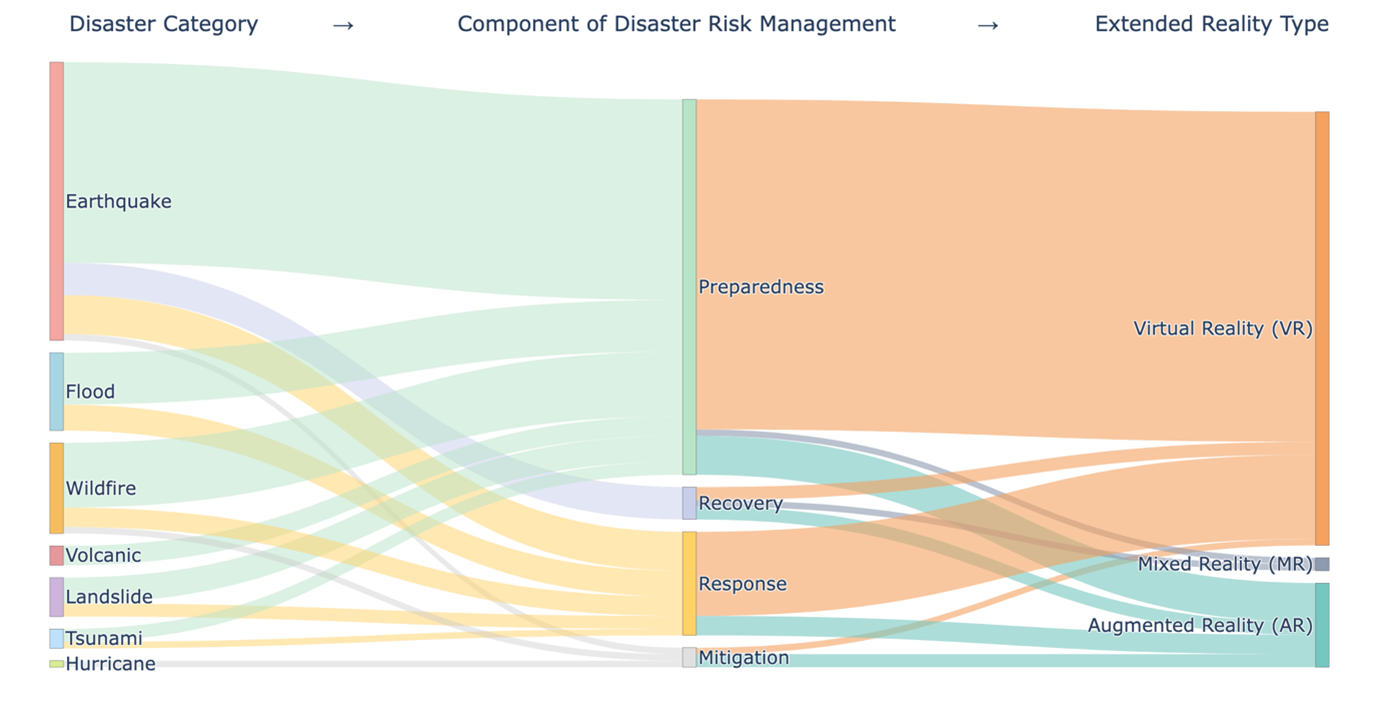
Virtual Reality (VR) provides fully immersive environments, making it particularly effective for preparedness and training, especially for difficult to predict events like earthquakes and landslides. It allows users to experience simulated disaster scenarios in a controlled setting, helping to build awareness and improve decision-making skills.
Augmented Reality (AR) overlays digital information onto the real world. This makes it valuable during response operations, where responders require real-time guidance, navigation, and situational awareness in dynamic environments, such as during floods or tsunamis.
Mixed Reality (MR) combines elements of both VR and AR, enabling interaction with digital objects within real-world settings. While this offers strong potential for planning and mitigation, its application in disaster contexts remains limited and requires further development.
These patterns suggest that current applications are shaped as much by technological accessibility as by actual operational needs. There is no single “best” XR technology for all disasters. Effectiveness depends on how well a tool aligns with the characteristics of a hazard and the specific phase of disaster risk management.
Matching technologies to context
Let’s now go beyond trends and understand why certain XR technologies overshadow others. Actually, there is no single “best” XR technology for any particular disaster or preparedness. Instead, the effectiveness depends on how well the technology matches the nature and demands of a given hazard.
A more practical way to look at this is through a tailored approach as detailed in Table 1. It is important to note that this table is not a fixed rule, but rather a guiding framework that helps in selecting the most suitable XR technology based on the nature of the disaster and the phase of disaster management.
| Disaster Type | Key Characteristics | Best XR Fit | Phase of Disaster Risk Management | Reasoning |
|---|---|---|---|---|
| Earthquake | Sudden, difficult to predict hazard | VR + MR | Preparedness + Mitigation | Requires behavioural training |
| Flood | Spatial and evolving hazard | AR | Response | Ideal for evacuation |
| Wildfire | Spatial, difficult to predict hazard | VR + AR | Preparedness + Response | VR for drills; AR for on-site evacuation |
| Landslide | Sudden, unpredictable hazard | VR + MR | Preparedness | Requires behavioural training |
| Tsunami | Spatial and evolving hazard | AR | Response | Ideal for evacuation |
| Volcanic Eruption | Sudden, geophysical processes | VR + MR | Preparedness + Mitigation | VR for simulation; MR for interactive planning |
| Cyclone/Hurricane | Spatial and evolving hazard | AR | Response | Ideal for evacuation |
Implications for disaster risk management
Current research and applications tend to favour technologies that are easier to deploy, particularly Virtual Reality (VR) for simulations. As a result, critical areas such as response and mitigation remain underexplored.
The suitability of XR technologies is not fixed. While each can be applied across multiple hazards and phases of disaster risk management, their effectiveness depends on how well they align with the characteristics of a specific hazard and operational needs. This highlights the importance of context-driven decision-making rather than one-size-fits-all approaches.
To move beyond demonstration-level use, greater emphasis is needed on applying XR in real-world settings, particularly for response and risk reduction planning. Strengthening this alignment can enhance risk communication, support more informed decision-making, and ultimately contribute to more resilient communities.
Sanjay Saifi is a PhD researcher in the Department of Civil Engineering at the Indian Institute of Technology (IIT) Bombay and is currently working as a Visiting Researcher at the Disaster Prevention Research Institute (DPRI), Kyoto University, Japan. His research focuses on disaster risk communication using geovisualization approaches to strengthen community resilience, preparedness, and decision-making processes.