UNDRR Logo
My account
Navigation loading…
  • Add
  • Your experience on PreventionWeb

    Please help us improve PreventionWeb by taking this brief survey. Your input will allow us to better serve the needs of the DRR community.

    See the survey

    Last updated 12 Nov 2026

    Half a degree matters to curb disaster risk

    Upload your content
    Image

    Introduction

    The difference between 1.5°C and 2°C of global warming may not seem significant. But research shows that failing to limit global warming at 1.5°C above pre-industrial levels will significantly increase disaster risk.

    Themes
    Climate change

    Knowledge base

    Smoke rising from factory chimneys at sunrise, symbolizing pollution and environmental impact.
    Research briefs
    9 November 2026
    Many regions have warmed beyond 1.5°C and some beyond 2°C, study finds

    A study, published in Nature Climate Change, indicates that at the regional level, many places on Earth have already surpassed 1.5°C (2.7°F), and suggests that other regions have warmed as much as 2°C (3.6°F) due to human-caused climate change.

    Eos - AGU
    Update
    11 June 2026
    Earth’s energy imbalance has doubled – here’s why that matters

    Heatwaves across Europe and south Asia have dominated the news recently. But these events are really a surface expression of more fundamental changes that are affecting our planet: the Earth itself is accumulating heat faster than ever before.

    Conversation Media Group, the
    A security officer takes a break in the middle of a hot afternoon in Bangkok, Thailand
    Research briefs
    26 January 2026
    Global population living with extreme heat to double by 2050

    A University of Oxford study finds that almost half the world’s population will be living with extreme heat by 2050 if the world reaches 2.0°C of global warming above pre-industrial levels – a scenario that climate scientists see as likely.

    Oxford Smith School of Enterprise and the Environment
    Update
    22 January 2026
    World on track to breach 1.5C target by 2030

    Global average temperature increases could pass the 1.5 degrees Celsius threshold outlined in the Paris Agreement by the end of the decade, according to the EU’s Copernicus Climate Change Service.

    Science and Development Network
    Update
    19 January 2026
    1.5 Degrees C: Understanding world’s critical warming threshold

    This article explains what exactly the 1.5 degrees C goal is, how was it set, and what happens if we exceed it? Here’s what to know.

    World Resources Institute
    Cover
    Documents and publications
    12 December 2025
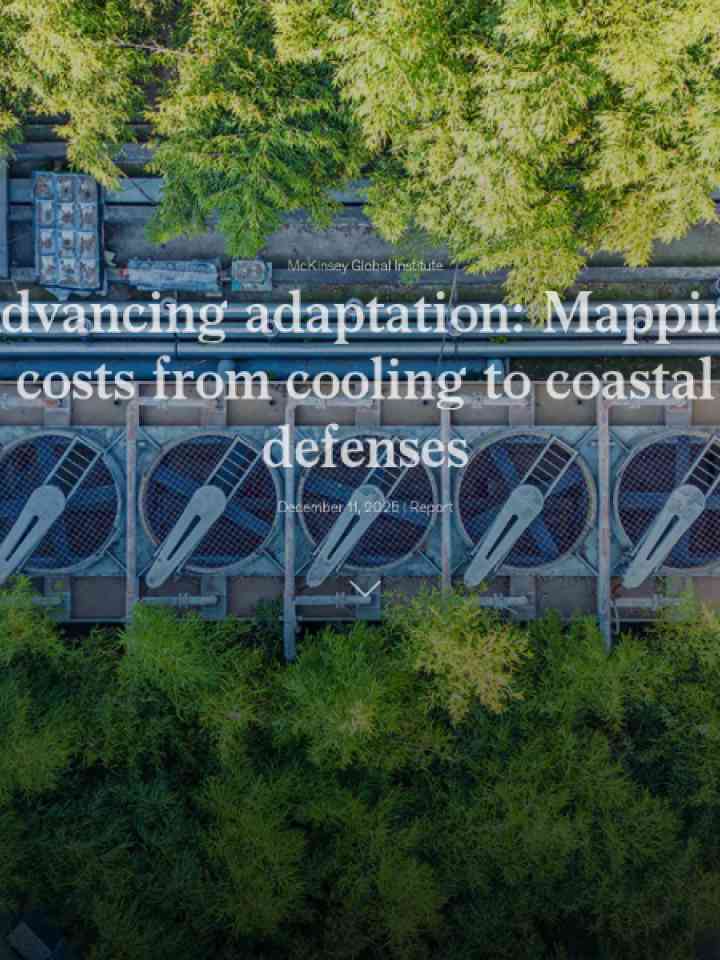
    Advancing adaptation: How evolving hazards could shape the agenda

    In this report, the authors undertake a first-of-its-kind comprehensive analysis of adaptation costs today and through 2050, using a granular, pixel-level, geospatial analysis.

    McKinsey & Company
    Cover
    Documents and publications
    4 June 2025
    Irreversible glacier change and trough water for centuries after overshooting 1.5 °C

    Exceeding 1.5 °C warming leads to irreversible glacier loss and water flow changes for centuries, increasing sea level rise and reducing runoff in key basins. Immediate emissions cuts are critical to avoiding lasting water and climate impacts.

    Nature Climate Change
    Petito Moreno glacier and lake in Patagonia, Argentina
    Research briefs
    30 May 2025
    Climate policy can save half of the world’s glaciers

    A study published in Science finds that twice as much of the world’s glacier mass could be preserved by meeting the 1.5°C threshold set by the Paris Agreement.

    Carnegie Mellon University
    Update
    20 May 2025
    1.5°C Paris Climate Agreement target too high for polar ice sheets and sea level rise

    Efforts to limit the global temperature increase to 1.5°C under the Paris Climate Agreement may not go far enough to save the world’s ice sheets, according to a new study.

    University of Bristol
    Update
    31 March 2025
    Big banks quietly prepare for catastrophic warming

    Morgan Stanley, JPMorgan and an international banking group have quietly concluded that climate change will likely exceed the Paris Agreement’s 2 degree C goal and are examining how to maintain profits

    Scientific American, a Division of Nature America, Inc.

    Pagination

    Showing results 1–10 on this page

    • 1
    • 2
    • Next

    Is this page useful?

    Yes No
    Report an issue on this page

    Thank you. If you have 2 minutes, we would benefit from additional feedback (link opens in a new window).

    PreventionWeb is the global knowledge sharing platform for disaster risk reduction (DRR) and resilience.

    • Newsletter
    • Submit your content
    • Blog pitches
    • Submission and publishing policy
    • About PreventionWeb
    • Contact us

    Hazards

    • Avalanche
    • Cold Wave
    • Cyclone, Hurricane and Typhoon
    • Drought and Desertification
    • Earthquake
    • Epidemic and pandemic
    • Flood
    • Heatwave, extreme heat and heat stress
    • Insect infestation
    • Land subsidence
    • Landslide
    • Nuclear, biological, chemical (NBC)
    • Sea level rise
    • Technological hazard
    • Thunderstorm
    • Tornado
    • Tsunami
    • Volcano
    • Wildfire

    Regions

    • Africa
    • Americas
    • Asia
    • Europe
    • Oceania

    Themes

    Understanding & managing risk

    • Preparedness
    • Early warning
    • GIS and mapping
    • Data and information management
    • Risk identification and assessment
    • Small Island Developing States
    • Earth Observation

    Natural environment

    • Climate change
    • Environment and ecosystems
    • Food security and agriculture
    • Water

    Cross-cutting

    • Systemic risk
    • Recovery

    Human development

    • Capacity development
    • Children and youth
    • Civil society / NGOs
    • Community-based DRR
    • Cultural heritage
    • Gender
    • Human mobility
    • Inclusion
    • Social impacts and resilience

    Science, knowledge & advocacy

    • Disaster risk communication
    • Traditional and Indigenous knowledges
    • Science-policy-practice interface

    State, governance & economy

    • Financing DRR
    • Fragility and conflict
    • Governance
    • Insurance and risk transfer
    • Private sector

    Infrastructure & critical services

    • Critical infrastructure
    • Education and school safety
    • Health and health facilities
    • Structural safety
    • Urban risk and planning
    Loading