1. Home
  2. Knowledge Base | PreventionWeb
  3. Themes

Food security and agriculture

Activities aimed to ensure access to and availability of adequate food supplies and the preservation of agricultural livelihoods under the pressures of climate hazards and food chains threats.

Crop resistance and household resilience – The case of cassava and sweetpotato in the Philippines

Latest Food security & agriculture additions in the Knowledge Base

Modeling cascading drought effects in a national food supply network using minimum cost flow thumbnail
Documents and publications

This study presents a spatial network optimization approach to model extreme drought impacts on Sweden’s food supply chain, revealing that supply losses in the south translate to unmet demand in the north and highlighting new bottlenecks in distribution.

Frontiers in Sustainable Food Systems
Food security benefits of more accurate weather forecasts in the context of a changing climate thumbnail
Documents and publications

This paper analyzes household survey and meteorological data from Ethiopia, Tanzania, Uganda, and Bangladesh, finding that more accurate weather forecasts reduce crop losses and help farmers adjust labor hiring, especially during extreme weather events.

Grantham Research Institute on Climate Change and the Environment
Green Leap – El Niño heating up inflation  thumbnail
Documents and publications

This research briefing analyzes how the intensifying El Niño and Indian Ocean Dipole will heighten drought and inflation risks in Africa by 2026/27, impacting food prices and regional economies; it recommends robust disaster risk management measures.

Oxford economics
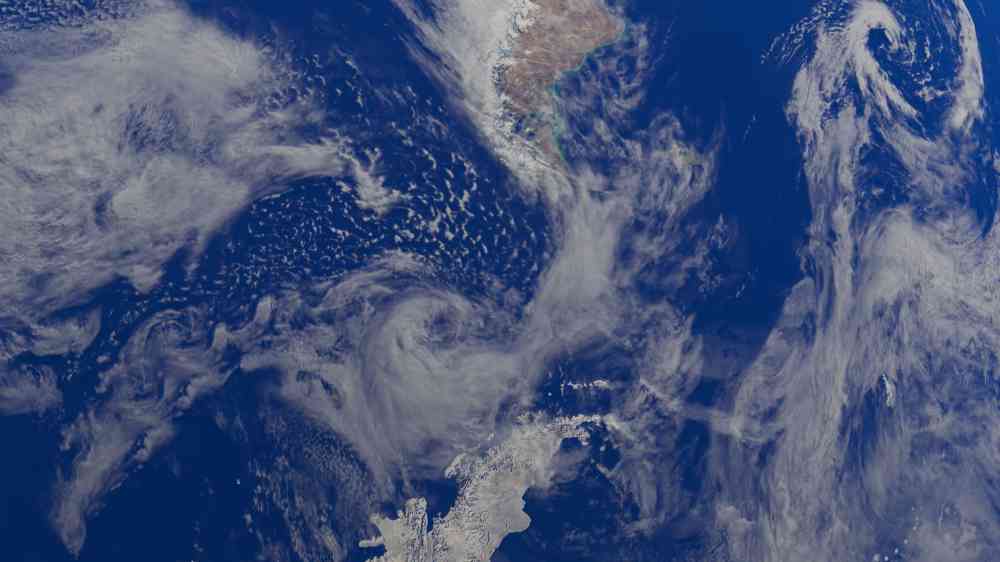
A mesmerizing satellite view showcasing Earth's clouds and ocean from space.
Update
El Niño and commodity prices in Kenya

Modelling by IFPRI and KIPPRA finds that El Niño-driven drought and higher fuel and fertilizer prices could cost Kenya up to 1.5 per cent of GDP in 2026, pushing 756,000 more people into poverty and 4.9 million into undernourishment.

International Food Policy Research Institute
Adaptation practices to climate change through crisis management: Evidence from farmers in Japan thumbnail
Documents and publications

This study explores how Japanese farmers adapt to climate change-related crises through crisis management. Findings indicate that Japanese farmers have a relatively moderate to high perception of climate change, but some farmers exhibit adaptive behavior.

Progress in Disaster Science (Elsevier)
Designing a parametric flood and drought insurance framework for Caribbean farmers and agricultural SMEs: Case studies of Belize and Saint Vincent and the Grenadines thumbnail
Documents and publications

This study develops a meso-level parametric flood and drought insurance model for smallholder farmers and SMEs in Belize and Saint Vincent and the Grenadines, leveraging blockchain to automate payouts, enhance resilience, and strengthen rural livelihoods.

Economic Commission for Latin America and the Caribbean (ECLAC/CEPAL)
Irrigation canals in agricultural field
Update
FAO Food Price Index rises in September amid weather concerns

FAO’s benchmark measure of world food commodity prices increased in September, due mostly to transportation disruptions and weather concerns that constrained availability as well as to higher quotations for crop-based commodity groups.

Food and Agriculture Organization of the United Nations (FAO)
Update
AU: As El Niño strengthens Australian farmers could face fierce frosts

For Australian farmers, frost risk is a growing concern. This is particularly true as the strengthening El Niño threatens to bring increasingly fierce and frequent frosts to farming regions.

Conversation Media Group, the
Case study
Location: Ecuador
Discover how this public-private partnership is strengthening the resilience of smallholder maize and rice farmers in Ecuador through an innovative parametric insurance solution that provides protection against drought and excess rainfall.
  • InsuResilience Solutions Fund
Update
How mountain terraces have helped Indigenous peoples

Indigenous communities have lived with changes to the climate for centuries. Their adaptations over those many years are based on their close observation of weathe and seasonal change, and they have been refined through generations of learning.

Conversation Media Group, the
“We do not wait helplessly”: How communities in Somalia are coping with a “double shock” drought thumbnail
Documents and publications

This bulletin examines how communities in Somalia are coping with a “double shock” drought, highlighting failing coping strategies, declining trust in official warnings, reduced aid, and the importance of supporting community-led responses.

Ground Truth Solutions
Sheep peacefully grazing in vibrant green countryside. Perfect for rural and agricultural themes.
Update
Europe: Flocks of nomadic sheep as a fix for extreme wildfires

Traditional transhumance and extensive grazing can reduce wildfire risk in southern Europe by removing dry vegetation, creating natural firebreaks and maintaining biodiversity, but declining pastoralism and weak incentives threaten the practice.

Bulletin of the Atomic Scientists, The
Update
Britain’s most artificial landscape may not survive climate change

Stretching across much of eastern England, the Fens produce a third of the country’s vegetables and support tens of thousands of jobs. Yet around 33% of the region lies below average sea level, while 87% is below the highest spring tides

Conversation Media Group, the
Update
India: Lumpy skin disease returns to J&K

Four years after Jammu and Kashmir witnessed its first major outbreak of LSD, it has resurfaced in the Union Territory, with fresh cases reported from Central Kashmir and authorities stepping up surveillance, vaccination, and veterinary intervention.

The Chenab Times
The effects of El Niño on global food security and nutrition thumbnail
Documents and publications

The brief compiles information from various sources to provide an updated, consolidated picture and monitoring of El Niño's effects on global food security.

European Commission
Low level of water is measured by a gauge on the Cantareira Jaguari dam during a severe drought in Sao Paulo state, Brazil.
Update
Lesotho: Red Cross Society acts ahead of an El Niño-driven drought

With El Niño threatening to disrupt upcoming rainfall and agricultural seasons, the LRCS activated its EAP for drought and begin implementing anticipatory actions to support the most vulnerable households. Heightened food insecurity is the main concern.

Anticipation Hub
Flood-tolerant rice seed deployment and satellite-based flood risk assessment for floodplain rice farmers thumbnail
Documents and publications

This report documents an integrated DRR field mission conducted by the GRMI in Katcha Ward, Niger State, on 10 July 2026. The mission combined agricultural support with geospatial flood risk assessment to better understand the exposure of rice farmers.

International Federation of Red Cross and Red Crescent Societies (IFRC)
Geohazards Risk Mapping Initiative
Artificial intelligence for agricultural drought risk reduction: A governance framework for climate-resilient water management thumbnail
Documents and publications

This paper develops an Adaptive AI-Enabled Drought Risk Reduction Framework, showing how AI can improve drought governance, water allocation and anticipatory decision-making when supported by trusted institutions and reliable data.

Progress in Disaster Science (Elsevier)
Update
Malawi: El Niño and rising fertilizer costs

Malawi faces significant economic and food security risks from overlapping El Niño impacts and Iran war fuel and fertilizer price shocks, a modeling exercise shows.

International Food Policy Research Institute
Bustling African market scene with fresh vegetables and shoppers in colorful clothing.
Update
As a mighty El Niño deepens global hunger, early action pays off

WFP is scaling up anticipatory action across Africa, Asia and Latin America to help vulnerable communities prepare for El Niño-linked droughts, floods and hunger through cash assistance, early warnings, farming support and resilience measures.

World Food Programme (WFP)
Update
Adaptation lessons from the global south

They explore the idea of appliances as “microinfrastructure”—from fans and air conditioners that reduce heat risk to refrigeration, cold storage, and solar water pumps that support food security and livelihoods.

America Adapts
Update
China warns of crop risks as heatwave sweeps agricultural regions

Sustained high temperatures may crimp yields while high humidity could raise risks of crop diseases

The Business Times
Update
France: Winemakers forecast 30-year low harvest after drought, heat

Estimates suggest drop in production with vineyards also concerned ‘smoke taint’ from wildfires may affect quality.

Guardian, the (UK)
Food market, Kilifi Kenya
Research briefs
Large disparities in access to food, water, and energy in 2050

In some regions of the world, the poorest people may spend about 50 percent of their income on food, while the richest spend about 5 percent.

MIT News, Massachusetts Institute of Technology
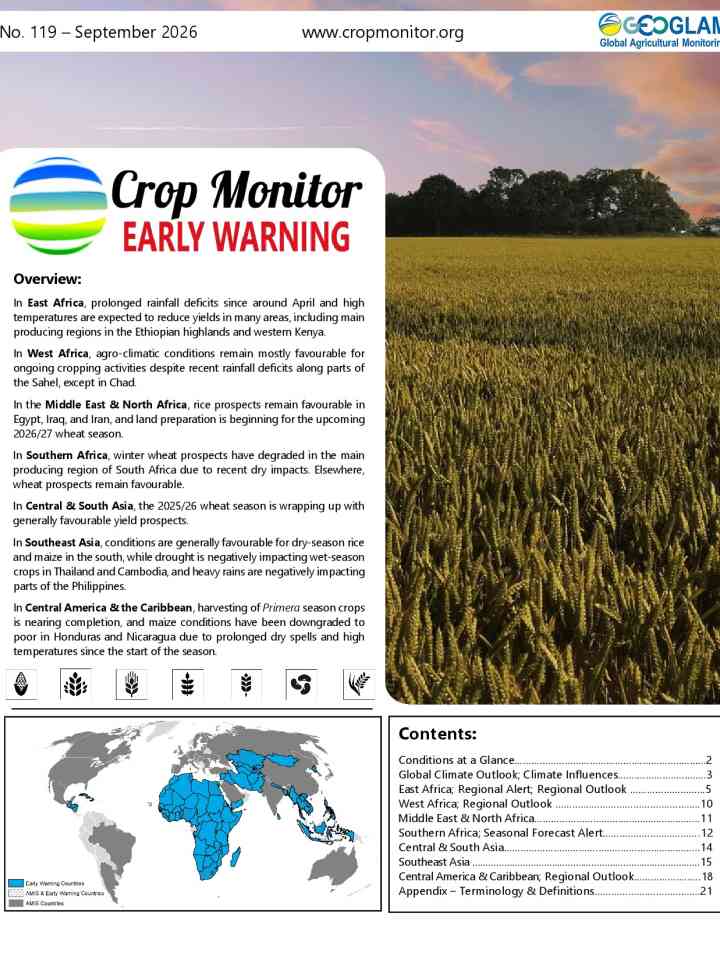
earlywarning_cropmonitor_202608.pdf thumbnail
Documents and publications

The September 2026 GEOGLAM Crop Monitor for Early Warning report provides an overview of global crop conditions with a focus on regions vulnerable to food insecurity.

Group on Earth Observations Global Agricultural Monitoring Initiative
Research briefs
Saltwater flooding could change which crops are worth growing

Saltwater isn’t something most people associate with English farmland. But in parts of eastern England, it’s becoming a growing problem, and not just for crops, but for farm incomes too.

Conversation Media Group, the
Drought adaptation mapping in the Southern African Development Community: A scoping review thumbnail
Documents and publications

This scoping review maps peer-reviewed evidence on drought adaptation in the SADC region, which exhibits an observed downward trend in precipitation, making it a valuable case to study diverse approaches to managing changing risk.

PLOS Climate
Large fisheries declines linked to compound and extreme climate events thumbnail
Documents and publications

Study finds extreme high ocean temperatures and low productivity, when combined, significantly increase the risk of fisheries declines worldwide. Risks are projected to intensify by mid-century, highlighting the need for adaptive fisheries management.

Nature Communications (Nature)
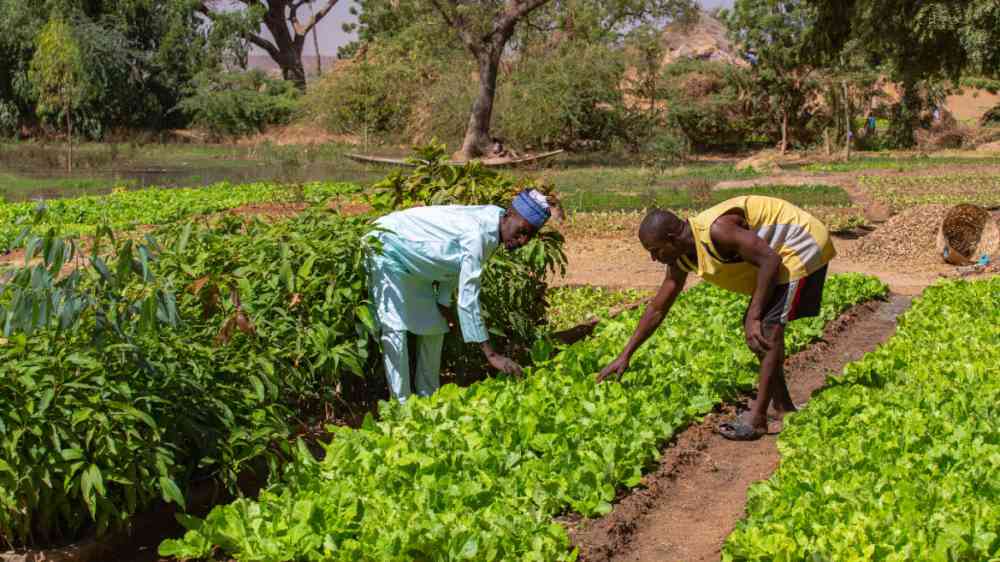
Two African men inspecting lettuce crops and a mango tree nursery on the fertile banks of the Niger river close to Niamey.
Update
Africa: How land restoration is transforming the Sahel

WFP’s community-supported initiative is restoring degraded ecosystems in five sub-Saharan African countries – building food security, incomes and bonds in the process.

World Food Programme (WFP)
Update
India: What climate resilience means for South Asia's farmers

South Asia’s small-scale farmers are facing mounting climate risks, but building resilience requires more than absorbing shocks—it demands adaptation, stronger institutions, finance and market access.

Observer Research Foundation
Update
France to ease strict rules on iconic cheeses as heat dries pastures

France is temporarily relaxing strict production rules for several iconic cheeses as drought and record heat leave pastures severely depleted.

France 24
Update
World’s breadbaskets are getting pounded by weather and trade spats

The breadbaskets of the world are getting pummeled by drone strikes and devilish weather, nudging prices higher amid already soaring food costs in the wake of the Iran war.

New York Times, the
Analysis for resilient and adaptive fisheries in Madagascar thumbnail
Documents and publications

World Bank assessment of climate risks to Madagascar’s fisheries, marine ecosystems and coastal communities, with recommendations for adaptation and resilience.

World Bank, the
Farming for 5-a-day: how resilient is the UK’s supply of fruit, veg and beans in a changing climate? thumbnail
Documents and publications

UK imports 80% of their fruit and 47% of their veg. Worsening climate means this reliance on imports poses a threat to their food and nutrition security. This report outlines opportunities to boost domestic production, resilience and nutrition security.

The Food Foundation
Update
What is El Niño, how does it affect hunger and how does WFP respond?

A strengthening El Niño could become one of the strongest on record, threatening food security for millions through 2027. WFP is scaling anticipatory action to reduce hunger risks from droughts, floods and climate-related shocks.

World Food Programme (WFP)
Analysis for resilient and adaptive fisheries in the Comoros thumbnail
Documents and publications

The report examines how climate change is expected to affect fisheries, marine ecosystems, and coastal communities in the Comoros through a combination of biophysical, economic, and social analyses.

World Bank, the
scPDSI reveals future agricultural drought hotspots in humid regions thumbnail
Documents and publications

This document examines projected changes in the severity and extent of agricultural drought across global croplands, addressing the challenges of consistently defining moisture deficits across different climatic zones.

International Journal of Disaster Risk Science
Research briefs
Solar panels can cool crops—and workers

A new model simulates the benefits of agrivoltaic farming, in which solar panels and crops share the same land.

Eos - AGU
Shiny delicious apples hanging from a tree branch in an apple orchard
Update
How climate change affects foodborne diseases

For many foodborne diseases, the environment plays an important role in transmission. As climate change increasingly affects global temperatures and weather events, the risks of transmission will increase.

Wellcome Trust
Farmer applies pesticide on a banana field.
Research briefs
Pesticides are more dangerous to farmworkers as it gets hotter

Research shows heat amplifies the dangers of pesticides for farmworkers, and that the problem is poised to grow as the global climate warms.

Inside Climate News
Update
What is the best way to grow food in a changing climate?

When most people picture British farming, they probably imagine fields of wheat, potatoes or vegetables stretching across the countryside. But some of the food on supermarket shelves is produced in environments that look very different.

Conversation Media Group, the
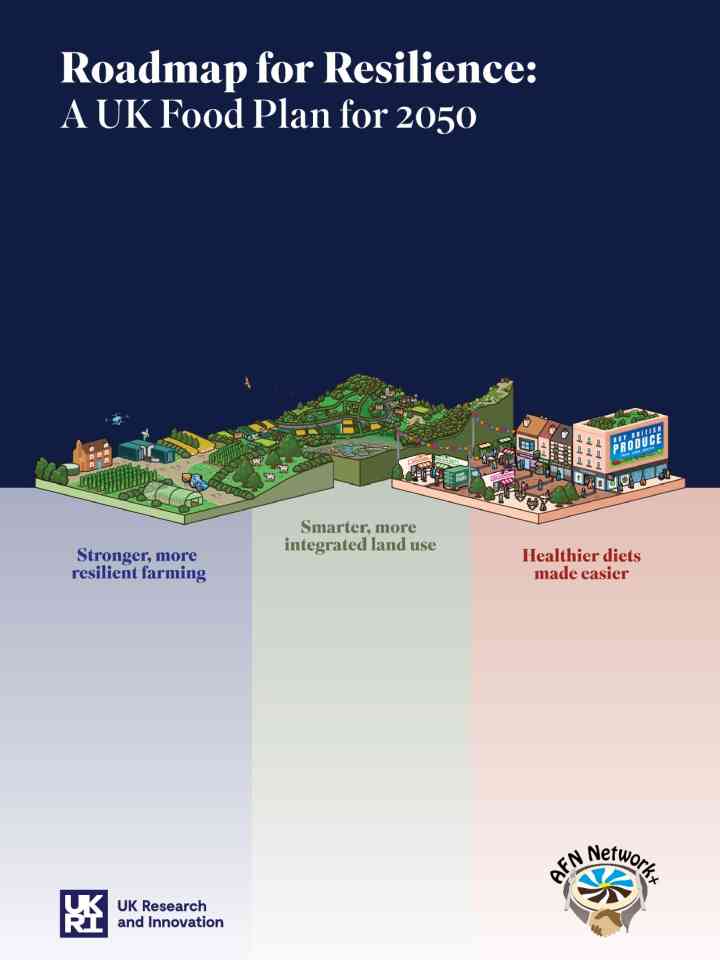
Roadmap for Resilience: A UK Food Plan for 2050 thumbnail
Documents and publications

This Roadmap, developed with input from over 150 experts through the AFN Network+ (UK Agri-Food for Net Zero Network+), offers practical pathways to transform UK's food system by 2050.

Root and Reason (The Agri-Food for Net Zero Network+)
Pathways to Climate-Smart Agriculture in Uzbekistan thumbnail
Documents and publications

This study describes the scope of Climate-Smart Agriculture adoption, farmers’ interest in these technologies, and the broader enabling environment, including the training and financial incentives needed to support adoption in Uzbekistan.

World Bank, the
Update
What is the best way to grow food in a changing climate?

The future of agriculture lies in balancing climate exposure and control costs. Fields, greenhouses and vertical farms will each play a role, supported by improved water management, energy efficiency and greater climate resilience.

Conversation Media Group, the
Update
UK: As severe drought hits, the food system faces crisis

The UK is in the grip of a severe drought.. The drought’s length and severity are affecting UK agriculture and food production.

Conversation Media Group, the
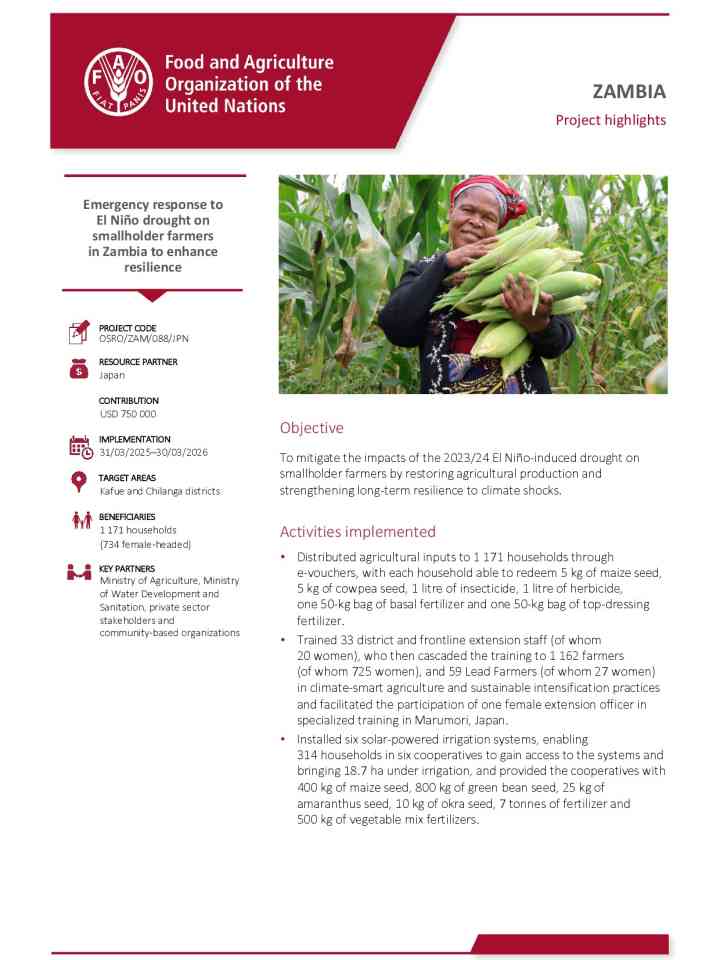
Emergency response to El Niño drought on smallholder farmers in Zambia to enhance resilience thumbnail
Documents and publications

This brief is about a project that was implemented by the Food and Agriculture Organisation of the United Nations (FAO) to help smallholder farmers recover from the 2023/24 El Niño-induced drought in Zambia.

Food and Agriculture Organization of the United Nations (FAO)
Farmers in the Americas working in the field
Update
Colombia expands parametric insurance for farmers

Colombian government has contracted five parametric agricultural insurance policies covering 14,402 smallholder farmers, benefitting up to 41,600 people across their households in five departments for up to US$20.14 million in coverage.

Insurance Development Forum
Update
UK: Which public services are struggling in hot weather?

As NHS told to prepare for extreme weather, strain also felt in other areas including transport and farming.

Guardian, the (UK)
Update
USA: Michigan winemakers have a new climate worry: More wildfire smoke

When wildfire smoke blanketed northern Michigan skies last month, Kasey Wierzba thought the vineyard at Shady Lane Cellars in Suttons Bay looked like a different planet.

Grist Magazine
Update
Southeast Asia’s workers face heat every day not just during heatwaves

For millions of workers across the region, acquiring that rice bowl is becoming increasingly difficult, putting people’s health at risk.

Global Heat Health Information Network (GHHIN)