UNDRR Logo
My account
Navigation loading…
  • Add
  • Your experience on PreventionWeb

    Please help us improve PreventionWeb by taking this brief survey. Your input will allow us to better serve the needs of the DRR community.

    See the survey

    Social Science in Humanitarian Action Platform

    SSHAP
    Non Governmental Organizations
    Propose an edit Upload your content

    Mission

    SSHAP (the Social Science in Humanitarian Action Platform) is a programme of work focusing on the social dimensions of emergency responses. 

    We work on emergencies that relate to health, conflict or the environment. We focus our efforts on exploring the political economy, community engagement and cultural logics, social difference and vulnerabilities of those emergencies.

    SSHAP is a partnership between the Institute of Development Studies, Anthrologica and the London School of Hygiene and Tropical Medicine and is funded by the UK Foreign, Commonwealth and Development Office and the Wellcome Trust. It has previously received funding from UNICEF, and their images continue to be used on this website with their kind permission.

    Our vision is to encourage emergency responses which are effective, adaptive, contextually informed, sensitive to vulnerabilities and power relations, planned in consultation with affected communities and local institutions, and based on social and interdisciplinary science and evidence.  

    With this in mind, one of our founding aims was to establish a network of social scientists with regional and subject expertise. This network is a driving force behind SSHAP’s work, rapidly providing insight, analysis and advice, tailored to demand and in accessible forms, to better design and implement the social and communication dimensions of emergency responses. 

    To achieve our aims, we work across four pillars:  

    1. we grow our existing network of experts and encourage interdisciplinary collaboration (academic-practitioner, social-medical science);  
    2. we provide knowledge and evidence on demand; 
    3. we build operational capacity;   
    4. we collect our resources and relevant resources from others and share them through our website. 
    Show more
    Latest additions
    Items: 22
    Documents and publications
    28 May 2021
    Broader health impacts of vertical responses to COVID-19 in Low- and Middle- Income Countries (LMICs)

    This paper reviews the effects of vertical responses to COVID-19 on health systems, services, and people’s access to and use of them in LMICs, where historic and ongoing under-investments heighten vulnerability to a multiplicity of health threats. We use

    Social Science in Humanitarian Action Platform
    This paper reviews the effects of vertical responses to COVID-19 on health systems, services, and people’s access to and use of them in LMICs, where historic and ongoing under-investments heighten vulnerability to a multiplicity of health threats.
    Documents and publications
    28 May 2021
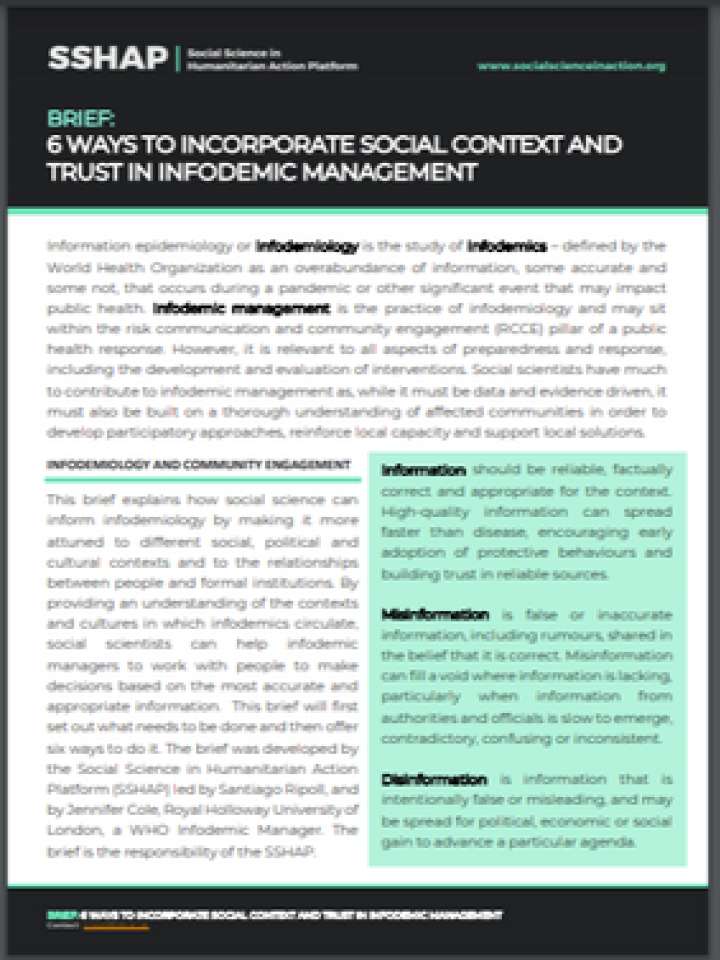
    6 ways to incorporate social context and trust in infodemic management

    This brief explains how social science can inform infodemiology by making it more attuned to different social, political and cultural contexts and to the relationships between people and formal institutions.

    Social Science in Humanitarian Action Platform
    This brief explains how social science can inform infodemiology by making it more attuned to different social, political and cultural contexts and to the relationships between people and formal institutions.
    Documents and publications
    28 May 2021
    Online information, mis- and disinformation in the context of COVID-19

    This brief sets out practical considerations relating to flows of information, misinformation and disinformation though online media, particularly social media networks, in the context of the COVID-19 pandemic. It details various types of online media

    Social Science in Humanitarian Action Platform
    This brief sets out practical considerations relating to flows of information, misinformation and disinformation though online media, particularly social media networks, in the context of the COVID-19 pandemic.
    Documents and publications
    28 May 2021
    Compliance with physical distancing measures for COVID-19 and implications for RCCE in Eastern and Southern Africa

    This brief reports on attitudes and practices relating to physical distancing measures in Eastern and Southern Africa in the context of the current global COVID-19 outbreak. Where relevant, it also includes insight and learning from the Ebola outbreaks in

    Social Science in Humanitarian Action Platform
    This brief reports on attitudes and practices relating to physical distancing measures in Eastern and Southern Africa in the context of the current global COVID-19 outbreak.
    Documents and publications
    28 May 2021
    Considerations and principles for shielding people at high risk of severe outcomes from COVID-19

    This brief considers the rationale for shielding individuals at high risk of severe disease or death from COVID-19 in low and middle-income countries. It provides an overview of proposed approaches to shielding, discusses the categories of individuals who

    Social Science in Humanitarian Action Platform
    This brief considers the rationale for shielding individuals at high risk of severe disease or death from COVID-19 in low and middle-income countries.
    Documents and publications
    28 May 2021
    COVID-19: why are prisons at particular risk, and what can be done to mitigate this?

    This brief provides key considerations related to COVID-19 in the context of prisons, jails and similar detention facilities (referred to collectively in this brief as “prisons”). It summarises the particular risks associated with an outbreak of COVID-19

    Social Science in Humanitarian Action Platform
    This brief provides key considerations related to COVID-19 in the context of prisons, jails and similar detention facilities (referred to collectively in this brief as “prisons”).
    Documents and publications
    28 May 2021
    Operational considerations: COVID-19 and forced displacement in the Middle East and East Africa

    This summary paper puts forward considerations of the ways in which humanitarian actors, civil society organisations and government departments with specific responsibilities towards displaced people can contribute to lessening vulnerabilities in this

    Social Science in Humanitarian Action Platform
    This summary paper puts forward considerations of the ways in which humanitarian actors, civil society organisations and government departments with specific responsibilities towards displaced people can contribute to lessening vulnerabilities in
    Documents and publications
    28 May 2021
    Background paper: COVID-19 in the context of forced displacement: perspectives from the Middle East and East Africa

    This background paper presents considerations on how the COVID-19 pandemic is accentuating existing vulnerabilities of populations forcibly displaced by war (refugees, asylum-seekers, internally-displaced and stateless persons), in settings across East

    Social Science in Humanitarian Action Platform
    This background paper presents considerations on how the COVID-19 pandemic is accentuating existing vulnerabilities of populations forcibly displaced by war (refugees, asylum-seekers, internally-displaced and stateless persons), in settings across

    Pagination

    Showing results 1–8 on this page

    • 1
    • 2
    • Next

    More content for this organization may be available on PreventionWeb or on the site search.

    Voluntary Commitments

    The organization has no registered commitments.

    The Sendai Framework Voluntary Commitments (SFVC) online platform allows stakeholders to inform the public about their work on DRR. The SFVC online platform is a useful toolto know who is doing what and where for the implementation of the Sendai Framework, which could foster potential collaboration among stakeholders. All stakeholders (private sector, civil society organizations, academia, media, local governments, etc.) working on DRR can submit their commitments and report on their progress and deliverables.

    Contact information

    http://www.socialscienceinaction.org/
    [email protected]

    Is this page useful?

    Yes No
    Report an issue on this page

    Thank you. If you have 2 minutes, we would benefit from additional feedback (link opens in a new window).

    PreventionWeb is the global knowledge sharing platform for disaster risk reduction (DRR) and resilience.

    • Newsletter
    • Submit your content
    • Blog pitches
    • Submission and publishing policy
    • About PreventionWeb
    • Contact us

    Hazards

    • Avalanche
    • Cold Wave
    • Cyclone, Hurricane and Typhoon
    • Drought and Desertification
    • Earthquake
    • Epidemic and pandemic
    • Flood
    • Heatwave, extreme heat and heat stress
    • Insect infestation
    • Land subsidence
    • Landslide
    • Nuclear, biological, chemical (NBC)
    • Sea level rise
    • Technological hazard
    • Thunderstorm
    • Tornado
    • Tsunami
    • Volcano
    • Wildfire

    Regions

    • Africa
    • Americas
    • Asia
    • Europe
    • Oceania

    Themes

    Understanding & managing risk

    • Preparedness
    • Early warning
    • GIS and mapping
    • Data and information management
    • Risk identification and assessment
    • Small Island Developing States
    • Earth Observation

    Natural environment

    • Climate change
    • Environment and ecosystems
    • Food security and agriculture
    • Water

    Cross-cutting

    • Systemic risk
    • Recovery

    Human development

    • Capacity development
    • Children and youth
    • Civil society / NGOs
    • Community-based DRR
    • Cultural heritage
    • Gender
    • Human mobility
    • Inclusion
    • Social impacts and resilience

    Science, knowledge & advocacy

    • Disaster risk communication
    • Traditional and Indigenous knowledges
    • Science-policy-practice interface

    State, governance & economy

    • Financing DRR
    • Fragility and conflict
    • Governance
    • Insurance and risk transfer
    • Private sector

    Infrastructure & critical services

    • Critical infrastructure
    • Education and school safety
    • Health and health facilities
    • Structural safety
    • Urban risk and planning
    Loading