Pasar al contenido principal
My account
Menu
Your experience on PreventionWeb

Please help us improve PreventionWeb by taking this brief survey. Your input will allow us to better serve the needs of the DRR community.

See the survey

Last updated 9 Jun 2026

El Niño-Southern Oscillation (ENSO)
Upload your content
Image

Introducción

The term El Niño is part of a broader phenomenon called El Niño-Southern Oscillation, or ENSO. It’s a recurring climate pattern involving changes in sea surface temperatures across the central and eastern tropical Pacific. The El Niño-Southern Oscillation is one of the planet’s most important natural mechanisms through which the ocean and atmosphere exchange energy and reorganize the global climate from year to year.

The phenomenon has three phases: the warm phase is El Niño, the cool phase is La Niña, and between the two lies a neutral or transitional phase, when neither dominates clearly. Although El Niño originates in the equatorial Pacific Ocean, its effects extend to other regions of the planet through processes known as climate teleconnections – atmospheric links that allow massive cloud formations to develop as a result of the enormous evaporation generated by the warming of ocean waters.

Also, when the natural phenomenon of El Niño coincides with a planet already warmed by human activity, its effects can be amplified. The World Meteorological Organization warned that during the last El Niño period (2023–2024), the combination of El Niño and climate change hit Latin America and the Caribbean with greater force, worsening droughts, heat waves, wildfires, extreme rainfall, and other impacts with significant human and economic costs.

Understanding these phenomena can help inform early warning and boost preparedness efforts.
The development of El Niño increases the chance of breaking temperature records and drives extreme weather events affecting infrastructure, food and energy systems around the world. View the playlist.

Knowledge base

Novedades
1 Junio 2026
Comienza la temporada de huracanes del Atlántico de 2026: un fuerte El Niño podría traer menos tormentas

“Pero basta con una sola tormenta para que la temporada sea muy mala”, dijo Ken Graham, director del Servicio Meteorológico Nacional de la NOAA.

Yale Climate Connections
Rain clouds at the coastline
Novedades
6 Mayo 2026
Cinco cosas que debes saber sobre El Niño

Y cómo el cambio climático lo afecta.

Yale Climate Connections
Novedades
20 Abril 2026
Cómo podría impactar el "Súper El Niño 2026" en el Mundial de Fútbol

Con el fenómeno de El Niño alcanzando niveles potencialmente históricos, la logística y el rendimiento físico en el Mundial de EE. UU., México y Canadá podrían verse afectados de manera crítica.

Instituto Interamericano para la Reducción de Riesgos de Desastres (IIARRD)
Rain clouds at the coastline
Novedades
6 Febrero 2026
Una nueva y mejor manera de monitorear El Niño y La Niña

Desarrollada en respuesta a un mundo que se calienta, la escala revisada de la NOAA identifica con mayor precisión qué episodios son los que probablemente tendrán los mayores impactos.

Yale Climate Connections
Novedades
11 Junio 2025
¿La Niña y El Niño aumentan o disminuyen la formación de ciclones?

El Dr. Rafael Méndez Tejeda explica cómo estos fenómenos meteorológicos afectan el clima extremo, como los huracanes

Yale Climate Connections
Cover
Documents and publications
15 Agosto 2023
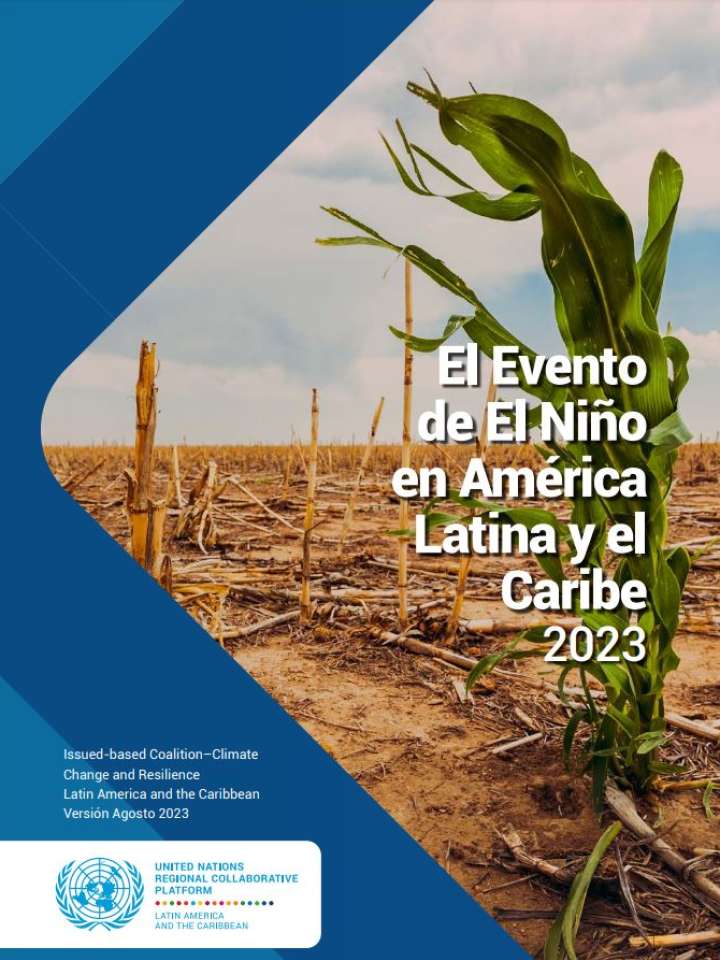
El Niño en América Latina y el Caribe

Este resumen regional fue preparado por la Coalición Temática (IBC) de América Latina y el Caribe (ALC) sobre Cambio Climático y Resiliencia. Esta IBC forma parte de la Plataforma de Colaboración Regional para ALC (RCP ALC).

United Nations Office for Disaster Risk Reduction – Regional Office for the Americas and the Caribbean
Food and Agriculture Organization of the United Nations (FAO)
World Meteorological Organization (WMO)
United Nations Environment Programme (UNEP)
Documents and publications
21 Diciembre 2017
Evolución, vulnerabilidad e impactos económicos y sociales de El Niño 2015-2016 en América Latina

El presente artículo documenta en detalle la evolución de las variables oceánicas y atmosféricas más relevantes durante el evento cálido El Niño 2015-16, así como sus manifestaciones sobre América Latina en lo relacionado con precipitaciones.

University of Alicante

Is this page useful?

Yes No
Report an issue on this page

Thank you. If you have 2 minutes, we would benefit from additional feedback (link opens in a new window).

PreventionWeb is the global knowledge sharing platform for disaster risk reduction (DRR) and resilience.

  • Newsletter
  • Submit your content
  • Blog pitches
  • Submission and publishing policy
  • About PreventionWeb
  • Contact us

Hazards

  • Avalanche
  • Cold Wave
  • Cyclone, Hurricane and Typhoon
  • Drought and Desertification
  • Earthquake
  • Epidemic and pandemic
  • Flood
  • Heatwave, extreme heat and heat stress
  • Insect infestation
  • Land subsidence
  • Landslide
  • Nuclear, biological, chemical (NBC)
  • Sea level rise
  • Technological hazard
  • Thunderstorm
  • Tornado
  • Tsunami
  • Volcano
  • Wildfire

Regions

  • Africa
  • Americas
  • Asia
  • Europe
  • Oceania

Themes

Understanding & managing risk

  • Preparedness
  • Early warning
  • GIS and mapping
  • Data and information management
  • Risk identification and assessment
  • Small Island Developing States
  • Earth Observation

Natural environment

  • Climate change
  • Environment and ecosystems
  • Food security and agriculture
  • Water

Cross-cutting

  • Systemic risk
  • Recovery

Human development

  • Capacity development
  • Children and youth
  • Civil society / NGOs
  • Community-based DRR
  • Cultural heritage
  • Gender
  • Human mobility
  • Inclusion
  • Social impacts and resilience

Science, knowledge & advocacy

  • Disaster risk communication
  • Traditional and Indigenous knowledges
  • Science-policy-practice interface

State, governance & economy

  • Financing DRR
  • Fragility and conflict
  • Governance
  • Insurance and risk transfer
  • Private sector

Infrastructure & critical services

  • Critical infrastructure
  • Education and school safety
  • Health and health facilities
  • Structural safety
  • Urban risk and planning
Loading