Country risk and governance profiles

Uncover the trends of disaster risk and learn more about country-level capacities to prevent disasters.

Understanding disaster risk is crucial for effectively preventing disasters. This page provides comprehensive and up-to-date risk profiles for countries around the world. The profiles offer in-depth information on risk for each country; they help identify and prioritize risk, guiding risk management.

Access detailed reports on each country's vulnerability, exposure, and resilience to various hazard types, explore informative maps that visualize disaster risks, and understand key indicators and metrics used to assess disaster risk.

Are you interested in global-level data? Explore last year's global losses and view global statistics.

Uploaded on
This image shows the coverpage of "Climate risk country profile: Ecuador"
Documents and publications

This paper assesses a climate risk country profile for Ecuador. With its wide range of climate zones, Ecuador has an extraordinary array of geographical systems, which range from high altitude glaciers to tropical rain forests to dry tropical forest.

World Bank, the
Coverpage of "Climate risk country profile: Costa Rica"
Documents and publications

Costa Rica’s climate is characterized by annual patterns. These are periodically affected by fluctuations in the temperature of the surrounding oceans, interaction of the atmospheric circulation with the volcanic mountain, and El Niño/La Niña cycles.

World Bank, the
Cover and source: Global Earthquake Model Foundation
Documents and publications

This seismic risk profile of Brazil, produced by the Global Earthquake Model (GEM) Foundation summarizes key metrics of seismic risk, allowing stakeholders in risk management to get an overview of the risk in the country.

Global Earthquake Model Foundation (GEM)
Cover and title of publication
Documents and publications

Located on the South American mainland, Guyana experiences flooding, drought, and wildfires but is not highly exposed to hurricanes, volcanoes, or earthquakes. Guyana has yet to put into full force several pieces of resilience-building legislation.

United States Agency for International Development (USAID)
Cover and title of publication
Documents and publications

An island economy highly reliant on tourism, Grenada lacks a comprehensive disaster management law and tsunami early warning systems are severely lacking. But the country has developed financial capacity by participating in hazard insurance programs.

United States Agency for International Development (USAID)
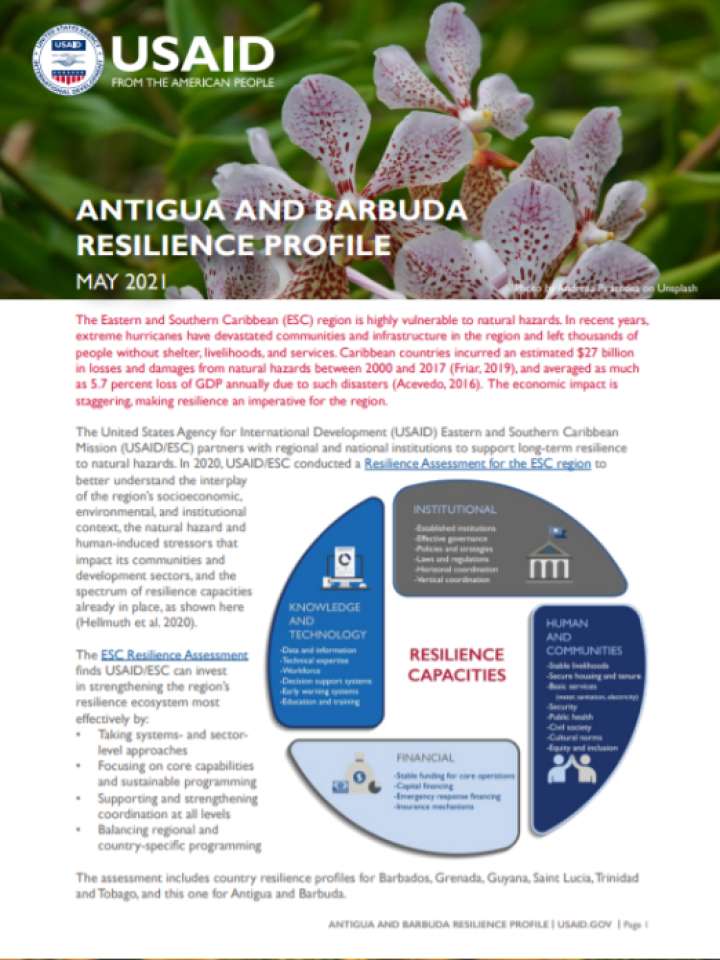
Cover and title of publication
Documents and publications

Antigua and Barbuda enjoys a strong tourism sector but it struggles with poverty, economic inequality, and unemployment. The country’s efforts to strengthen disaster management is hampered by its non-integration to national development planning.

United States Agency for International Development (USAID)
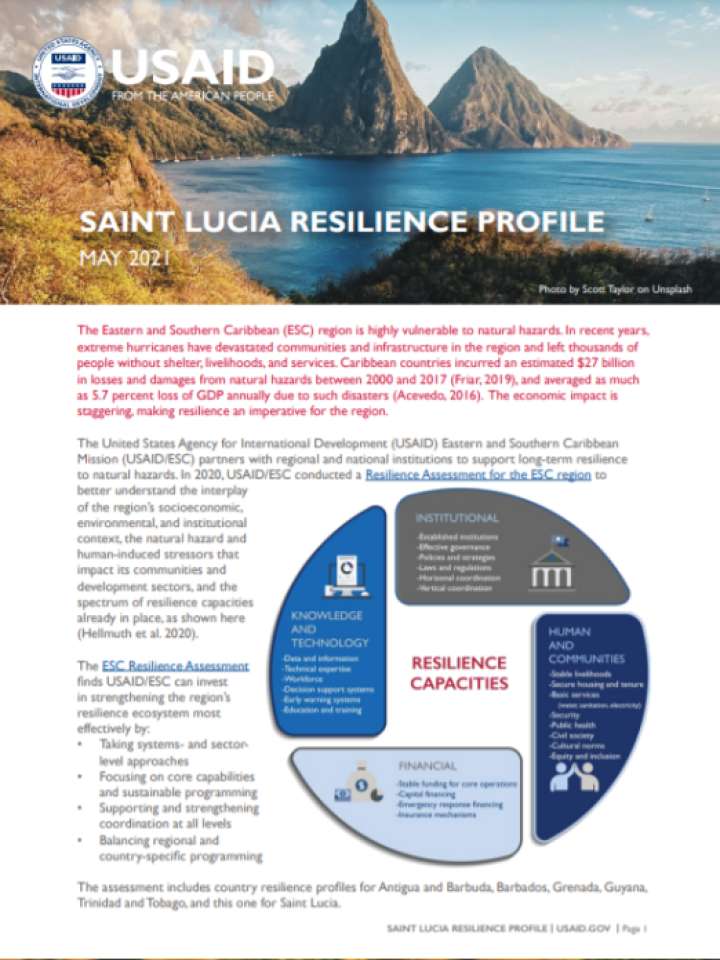
Cover and title of publication
Documents and publications

Like many of its neighbors, Saint Lucia faces earthquakes, hurricanes, tsunamis, landslides, volcanic activity, flooding, and drought. The nation’s disaster and emergency legislation is strong but must emphasize planning and mitigation.

United States Agency for International Development (USAID)
Cover and title of publication
Documents and publications

Mostly a low-lying country, Barbados faces flash floods, droughts, small-scale landslides, earthquakes, and fires. Its disaster and emergency management legislation and structure and data collection are strong but implementation is still lacking.

United States Agency for International Development (USAID)

illustration
Knowledge base
Explore the latest on disaster risk and resilience from around the world: news, research, policies and publications.
Regional resources