
Items: 19
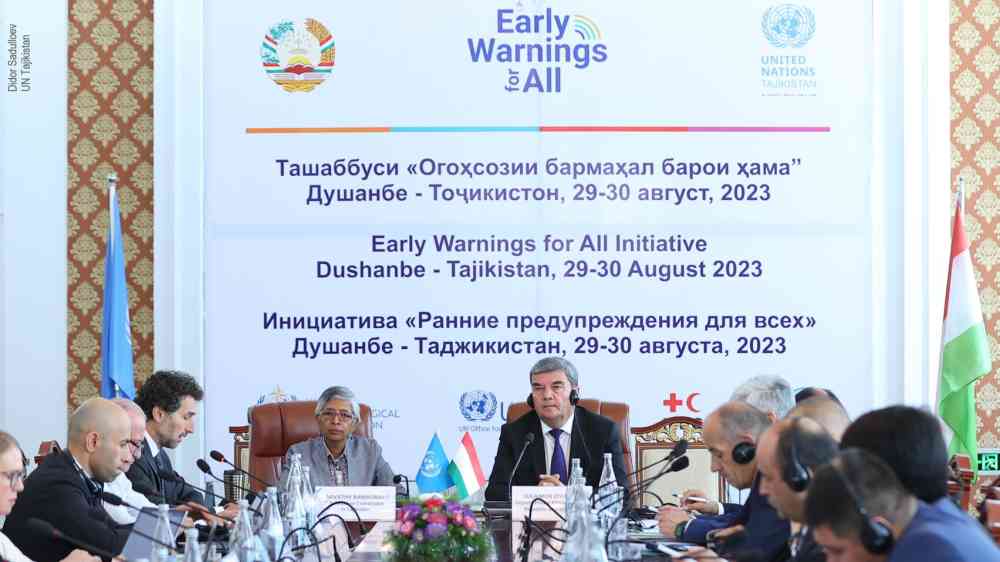
The UN Secretary-General’s Early Warnings for All Initiative (EW4All) was launched in Tajikistan during a two-day national consultation with key stakeholders from state and international agencies, UN, media and civil society organizations.
Tajikistan's Voluntary National Report for the Midterm Review of the Implementation of the Sendai Framework for Disaster Risk Reduction 2015-2030 (MTR SF).
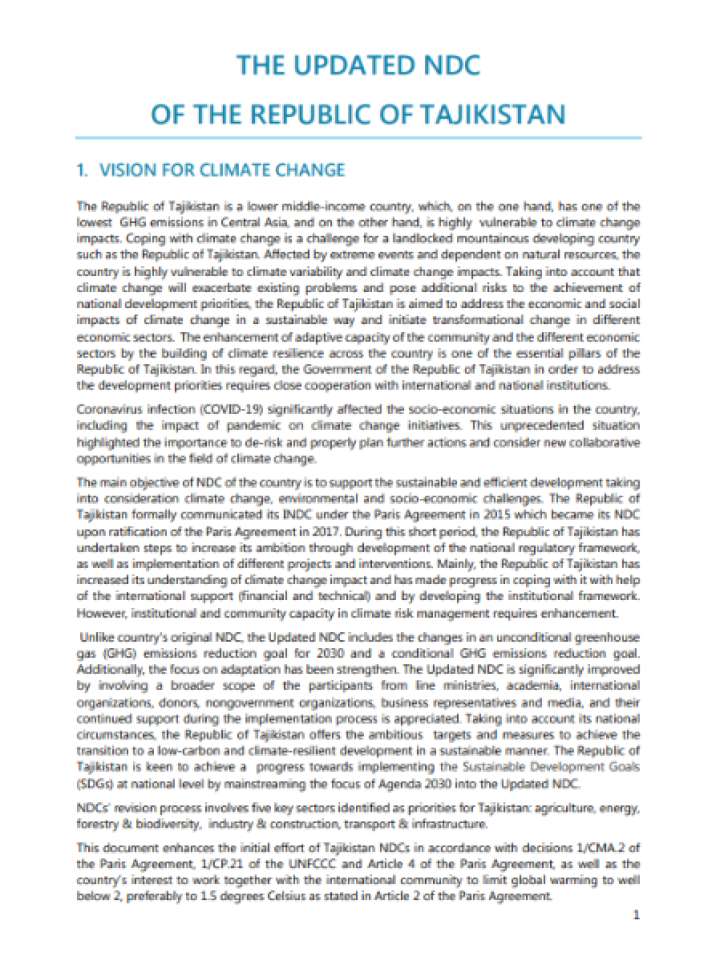
The main objective of the nationally determined contribution of the Republic of Tajikistan is to support sustainable and efficient development taking into consideration climate change, environmental and socio-economic challenges.
The overall goal of the National Action Plan is to reduce the existing and prevent the emergence of sand and dust storm risks, associated with the sand and dust storms through building national capacities for their management.
The National Strategy for Adaptation to Climate Change of the Republic of Tajikistan for the period up to 2030 is a multisectoral policy document applicable to risk assessment of climate change applicable to agriculture, land tenure and food security.
Taking into account the need to systematically reduce the impact of disasters on the Republic of Tajikistan, as well as realizing that disaster risk reduction (DRR) is a multilateral and complex issue constraining the country's sustainable develop
This policy seeks to decrease existing risks and prevent new ones in order to build Tajikistan's risk management capacity. To fulfill this goal, the policy outlines four risk management tasks.
The need for a Regional Platform for Disaster Risk Reduction for Central Asia and South Caucasus (CASC) to facilitate focused dialogue and strategic planning similar to the other regions has been strongly voiced in regional discussions leading up
Voluntary Commitments
The organization has no registered commitments.
The Sendai Framework Voluntary Commitments (SFVC) online platform allows stakeholders to inform the public about their work on DRR. The SFVC online platform is a useful toolto know who is doing what and where for the implementation of the Sendai Framework, which could foster potential collaboration among stakeholders. All stakeholders (private sector, civil society organizations, academia, media, local governments, etc.) working on DRR can submit their commitments and report on their progress and deliverables.