

Participate

Global Platform Highlights - Monday, May 20
posted: 20/5/2013
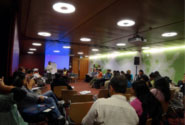
4th Global Platform official opening today
Record attendance
The 4th Global Platform for Disaster Risk Reduction opens today following two days of intense consultations among stakeholder groups on a whole range of topics from Demystifying Grassroots Partnerships through Improved Earthquake Risk Management for Governments to over 40 consultations on the Post-2015 Framework for Disaster Risk Reduction.
By end of day, 4,783 people had registered to attend online, and 2,485 people had been badged. This included 673 delegates from 165 governments, 634 UN and IGO representatives, 209 from 130 academic institutions, 159 VIPs and 19 Ambassadors, 100 from 67 private sector companies, and 372 from 209 NGOs.
Margareta Wahlström, UNISDR chief, highlighted that the 2013 Global Platform will “give special attention to three critical areas. The first is private sector investment in disaster risk management – an opportunity to create shared value for businesses and corporations as well as for society. The second is the work of local communities, networks and supporting policies in building resilience. The third is local and national governments, and their take on implementation of the HFA as well as on an action agenda for building disaster resilience in a post 2015 successor framework.”
The event is an important milestone before the 2015 World Conference on Disaster Risk Reduction in Japan in 2015.
Quote of the Day:
“I don’t lack vision I just lack sight” – Senator Monthien Buntan of Thailand, a blind member of the Disability Inclusive DRR Network for Asia Pacific.
Private Sector Partnerships for DRR comes of age
The private sector as a DRR actor came of age yesterday with the holding of the first Annual General Meeting of the Private Sector Partnerships for Disaster Risk Reduction - under the chairmanship of Aris Papadopoulos, CEO of Titan America.
He said that the UNISDR Private Sector Advisory Group wanted to become “a catalyst for action, working to promote public and private partnerships.”
Sandra Wu, Chairperson and CEO, Kokusai Kogyo Co. Ltd, said it was now time “to move on and set goals and find solutions.”
Caroline Woolley of Marsh, UK, said relationships between the public and private sectors were improving as the private sector shared its insurance expertise, warnings and relevant technologies with communities.
Other contributors stressed the importance of the private sector in ensuring the quality of buildings, the resilience of the wider environment and developing the insurance market for high-risk disaster scenarios. The major disasters which occurred in 2011 and 2012 had a dramatic effect on business and acted as a wake-up call.
HFA2 Consultations
The following points were made at the consolidation of Stakeholder Group Discussions. A more detailed account is available on the Global Platform web site/
Parliamentarians from 26 countries are attending the GP, and Senator Philippe Mahoux said the HFA2 should recognise parliamentarians as important stakeholders with a critical role to play in the implementation of the HFA2 .…
Violetta Shivutse from the Community Practitioners Platform said “we are not only working for disaster resilience but to change the very way that development is done.”…
Aris Papadopolous of the Private Sector said the whole urban eco-system has to be made resilient ….
Cletus Springer, Director, OAS, said there was a need to raise the awareness of Heads of State and platforms for disaster risk reduction should be owned by governments…
Walter Ammann of the Science and Technology Group said science and technology needs to be more demand and user-driven and also to integrate the social sciences…
Marcus Oxlee for the NGO group said community resilience should be at the heart of the HFA2, transparency and accountability were critical and the process must be one of genuine partnership and meaningful participation…
Mohammed Boussraoui of UCLG said more decentralisation and financial support was needed for DRR at local government level…
Helena Lindberg speaking on behalf of the National Platforms (NPs) said there was a need to increase their number by 2015 and they should be brought into the HFA2 and they should be used more to promote DRR to policy and decision-makers.
Governments back DRR
Government consultations on DRR in a Post-2015 Development Agenda heard that poorly planned development drives disaster risk and that there is a need to align risk reduction efforts much more explicitly within the coming Sustainable Development Goals.
UNDP’s Assistant Secretary-General and Director for Development Policy Olav Kjorven hailed the current ‘open conversation’ that engages global citizens as part of the process to replace the Millennium Development Goals post-2015.
Dr Tom Mitchell of ODI, based in London, warned that there is ‘significant competition from other issues to be a part of the Sustainable Development Goals’.
Disability and HFA2
The Disability Inclusive DRR Network for Asia Pacific has called for HFA2 to be much more sensitive to people with disability.
The Network said reference to disability in the current HFA is ‘poor’. ‘The Framework does not recognize the increased risk that people with disability face nor the positive contribution that people with a disability can make within DRR.’
Alex Robinson of the Network said: “Can various NGOs really say they are working with the most vulnerable if they are not working with the disabled.” The Network is calling for disability to be approached as a developmental and human rights issue not one that is simply based on medical or charity approaches.
UN DPI: Private-public partnerships needed for disaster risk reduction
UN DPI: National disaster risk reduction should involve all stakeholders, clear mandates
UN DPI: Experts urge greater role for private sector in disaster risk reduction
UN DPI: Stakeholders in disaster risk reduction stress need for community involvement, resilience, addressing root causes
UN DPI: Les experts insistent sur le renforcement des partenariats avec le secteur privé pour réduire les risques de catastrophe
UN DPI: Rôle des plates-formes nationales dans l’élaboration du Cadre d’action post-2015 pour la réduction des risques de catastrophe
UN DPI: Une prise de conscience mondiale du problème de la préparation aux risques de catastrophe est nécessaire
UN DPI: Les grands groupes discutent de leur contribution au Cadre d’action post-2015


