 |
Global Assessment Report on Disaster Risk Reduction 2013
From Shared Risk to Shared Value: the Business Case for Disaster Risk Reduction |
|
Global Assessment Report on Disaster Risk Reduction 2013
From Shared Risk to Shared Value: the Business Case for Disaster Risk Reduction |

|
Many low and middle-income countries lack capacities to reduce their vulnerabilities
Businesses that invest in hazard exposed low and middle-income countries may face increased disaster risk, not only as a result of increasing exposure but also because these countries have not yet developed the capacities to reduce their vulnerabilities. If businesses do not factor these vulnerabilities into their investment decisions, they may be assuming risks and liabilities that will only become apparent when hazard events occur.
Most disasters that could occur have not happened yet
Extreme hazard events, like catastrophic earthquakes or tsunamis, may only happen every five hundred or one thousand years in any given place.
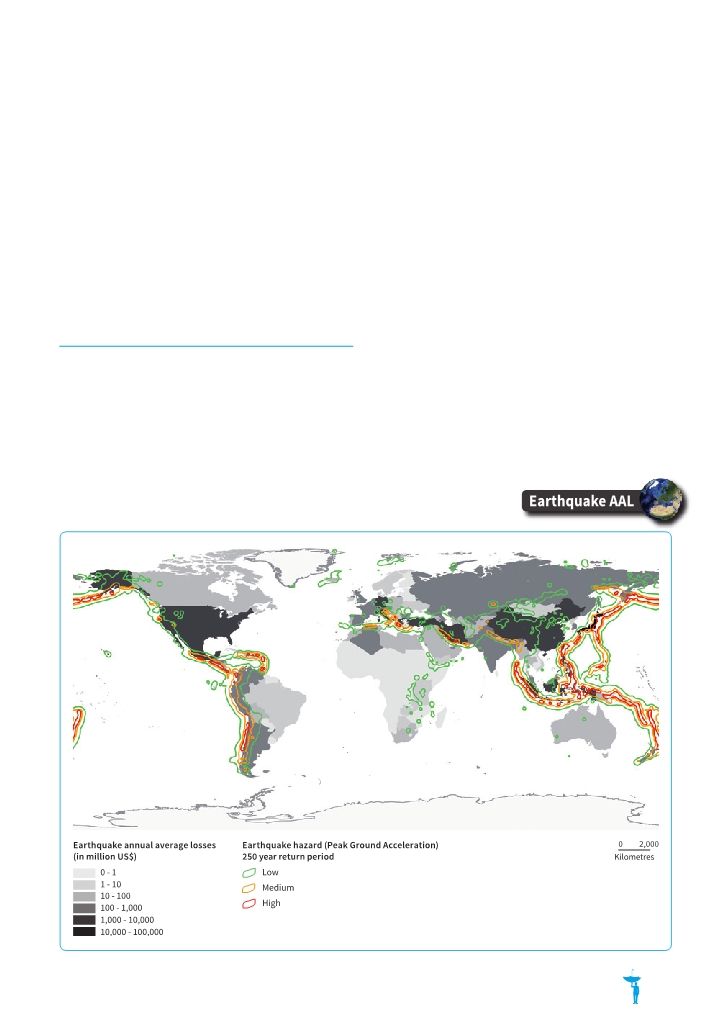
As such, most of the events that could potentially occur have not happened yet. Although data on historical disaster loss provides a guide to the recent past, it is insufficient to predict and estimate the losses that may occur at present and in the future. To overcome this problem a probabilistic approach to risk modelling has been used, for example to estimate the losses that could potentially occur from a one-in-250 year earthquake (a 0.4 percent probability of occurrence in any given year) or annual average losses, which is the expected average loss per year from all the events that could potentially occur.
Smaller countries have the highest proportion of their capital stock at risk
Total global annual average loss for earthquakes is estimated at more than US$100 billion and for wind damage from tropical cyclones at more than US$80 billion. In absolute terms, most loss is concentrated in high-income countries such as Japan and the
|


|