 |
Global Assessment Report on Disaster Risk Reduction 2013
From Shared Risk to Shared Value: the Business Case for Disaster Risk Reduction |
|
Global Assessment Report on Disaster Risk Reduction 2013
From Shared Risk to Shared Value: the Business Case for Disaster Risk Reduction |

|
about 67 percent. The implication is that the headline-grabbing figures recorded in global datasets11 over the last decade may be quite conservative. Once the losses associated with nationally reported smaller disasters are included, those figures are likely to be at least 50 percent higher. At the same time, these figures refer only to direct losses and thus exclude the cost of indirect losses and wider effects of disaster
THE HIDDEN RISKS OF ECONOMIC GLOBALISATION
Decentralisation and outsourcing has led to spectacular increases in produced capital
Since the last economic crisis of the mid-1970s, globalization has transformed the world beyond recognition. As spatial barriers to investment have been eroded many large businesses have decentralized, outsourced or off-shored all or part of their operations to different locations worldwide. As a result, in those low and middle-income countries that have
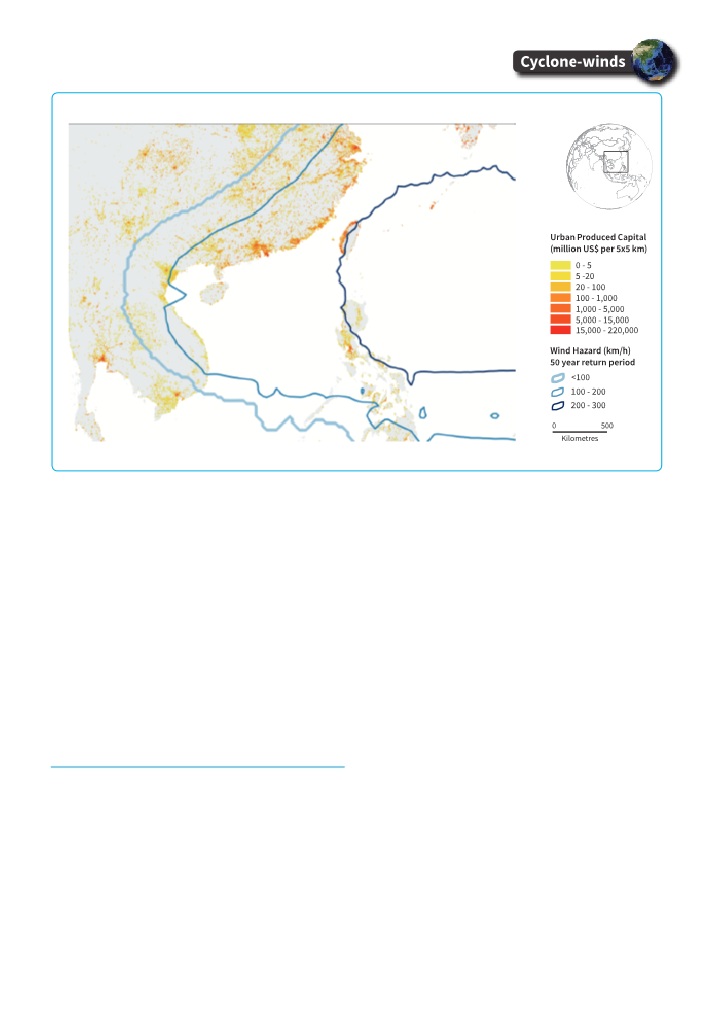
been successful in attracting investment there have been spectacular increases in the value of produced capital. In East Asia and the Pacific,12 for example, this value more than doubled from US$4.6 trillion in 1995 to US$10 trillion in 2005 (Figure 3).
The benefits of globalisation have been accompanied by growing hazard exposure
Businesses have enhanced their productivity and profitability by taking advantage of attractive labour costs and skills, easy access to export markets, good infrastructure, a stable economic and political environment, and many other factors. However, some of the regions that have attracted this investment are hazard-exposed. In these regions, in parallel with the benefits from globalisation, the proportion of population and economic assets in tsunami and cyclone-prone coastlines, flood-prone river basins and earthquake-prone mega-cities has grown. For example, between 1970 and 2010 the proportion of global GDP exposed to tropical cyclones increased from 3.6 percent to 4.3 percent.13
Figure 3 Produced capital stock in Southeast Asia exposed to one-in-50 year tropical cyclone wind hazard
|


|