 |
Global Assessment Report on Disaster Risk Reduction 2013
From Shared Risk to Shared Value: the Business Case for Disaster Risk Reduction |
|
Global Assessment Report on Disaster Risk Reduction 2013
From Shared Risk to Shared Value: the Business Case for Disaster Risk Reduction |

|
United States of America, reflecting the value of their exposed capital stock. Japan alone has 15 per cent of the world’s urban produced capital. However, smaller countries have a higher proportion of their capital stock at risk and in lower income countries the vulnerability of buildings also increases risk. A number of small island developing states could lose over 20 percent of their capital stock in a catastrophic one-in-250 year cyclone or earthquake.
The location of critical facilities in tsunami-exposed areas increases risk
In the case of extremely destructive one-in-500 year
tsunamis Japan has more than 15 percent of its produced capital and 12 percent of its population exposed. But other smaller countries, such as Maldives, also have very high relative exposure. Many critical facilities, including nuclear power plants and airports, are located in areas exposed to destructive tsunamis. Airport exposure is most critical in small island states, whose economies may depend on a single airport or where all airports will be affected at the same time. In French Polynesia, for example, a total of 26 airports are exposed.
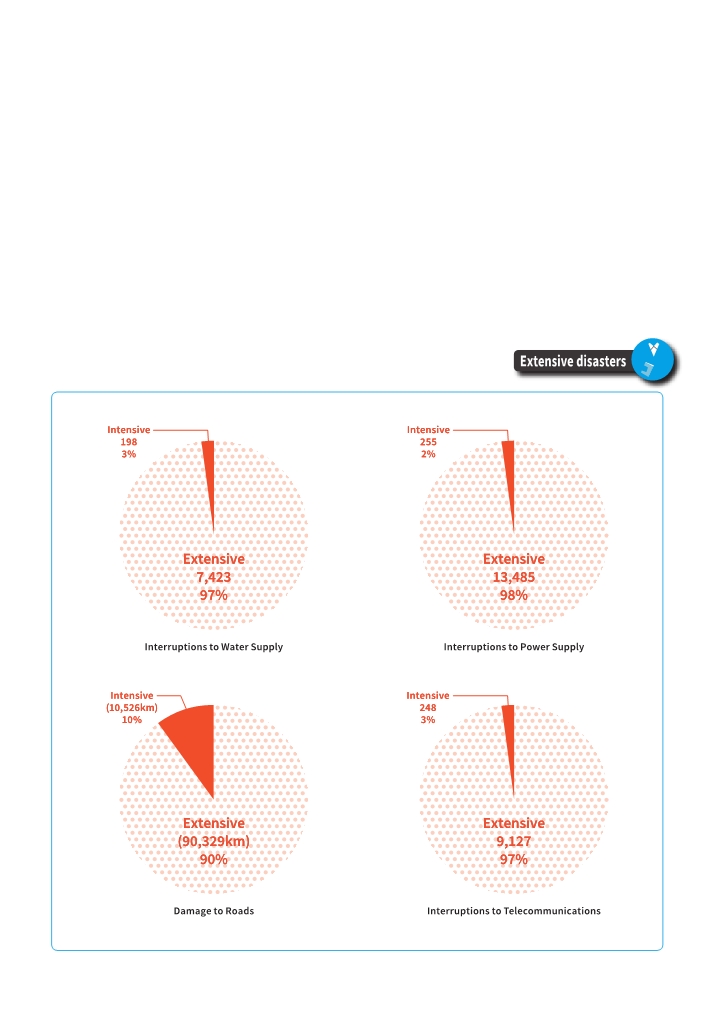
Figure 5 Absolute number and proportion of infrastructure damaged in extensive disasters in 56 countries and 2 Indian states, 1970 – 2011
|


|