 |
Global Assessment Report on Disaster Risk Reduction 2013
From Shared Risk to Shared Value: the Business Case for Disaster Risk Reduction |
|
Global Assessment Report on Disaster Risk Reduction 2013
From Shared Risk to Shared Value: the Business Case for Disaster Risk Reduction |
|
|


|
215
tions, which were previously subject to state monopolies (Kyrili and Martin, 2010
Kyrili, K. and Martin, M. 2010.,The Impact of the Global Economic Crisis on the Budgets of Low-Income Countries., A report for Oxfam by Development Financing International., Oxford, UK:,Oxfam International.. . Babb, S. 2005.,The Social Consequences of Structural Adjustment. Recent Evidence and Current Debates., Annual Review of Sociology, Vol. 31 (2005): pp. 199-222.. . Bouton, L. and Sumlinski, M.A. 2000.,Trends in Private Investment in Developing Countries. Statistics for 1970-1998., IFC Discussion Paper No.41. World Bank., Washington D.C,USA.. . Epstein, G., Grabel, I. and Jomo, K.S. 2003.,Capital management techniques in developing countries: an assessment of experiences from the 1990s and lessons for the future., Presented at the XVIth Technical Group Meeting (TGM) of the G-24., Port-of-Spain,Trinidad and Tobago.. .  Gerulis-Darcy, 2012  Gerulis-Darcy, M. 2012.,Implications of the Global Political Economy on Vulnerability to Disasters: The Case of Long-Term Structural Adjustment Policies in Nicaragua., Background Paper prepared for the 2013 Global Assessment Report on Disaster Risk Reduction., Geneva,Switzerland: UNISDR.. Click here to view this GAR paper. Lapvitsas, C., Kaltenbrunner, A., Lambrinidis, G., Lindo, D., Meadway, J., Michell, J., Painceira, J.P., Pires, E., Powell, J., Stenfors, A. and Teles, N. 2010.,The Eurozone between austerity and default., RMF Occasional Report, September 2010.. . Elkins, Z., Guzman, A. and Simmons, B. 2006.,Competing for capital: the diffusion of bilateral investment treaties, 1960-2000., International Organizations, Vol. 60. No. 4 (Autumn 2006), 811-846.. . OECD (Organisation for Economic Co-operation and Development). 2008.,Privatisation in the 21st Century: Recent Experiences of OECD Countries., Report on Good Practices., Paris,France: OECD.. . In parallel, governments began to play an active and explicit role as promoter and facilitator of private investment. Financial, property, labour and other markets were deregulated and liberalised; tariffs on trade were reduced or eliminated; and incentives
were provided for foreign investment. At the same time, in some countries, national mechanisms and institutions for development planning were either weakened or wound down (UNCTAD, 2012
UNCTAD (United Nations Conference on Trade and Development). 2012.,World Investment Report 2012: Towards a New Generation of Investment Policies., New York and Geneva.,. . Cernea, M. 2005.,The ‘ripple effect’ in social policy and its political content., In: Likosky, M.B. (ed.) Privatising Development: Transnational Law, Infrastructure and Human Rights., Leiden: Martinus Nijhoff.. . Likosky, M.B. 2009.,Contracting and regulatory issues in the oil and gas and metallic minerals industries., Transnational Corporations, Vol 18, No. 1 (April 2009).. . As a result, the global economy is increasingly characterised by geographical competition between countries and cities to attract investment on the basis of their real or perceived comparative advantages.
As described earlier in this report, SIDS compete to attract tourism investment; other countries with sig-
Box 14.3 Attracting new risk in Thailand
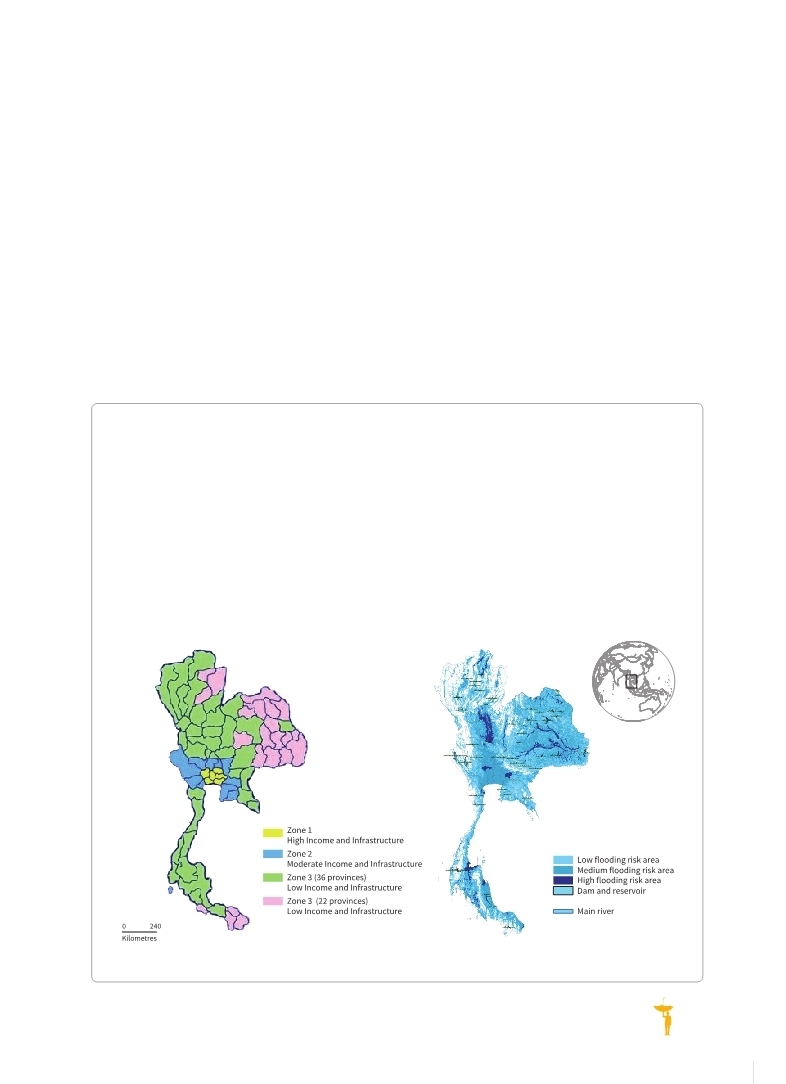
Thailand’s powerful Board of Investment (BOI) encouraged investment in three promotional zones vii —through tax privileges; sectoral incentives through BOI-identified priority projects; and privileges provided by the Industrial Authority of Thailand (IEAT). Although privileges offered in Zone 1, the areas surrounding Bangkok, were lower than those offered in regions further inland, they were still substantial, including corporate tax exemption for 3 years and a 50 percent reduction on import duty for machinery (BOI, Government of Thailand, in: Thampishvong, 2012). Although this policy was successful in attracting FDI, it led to massive increases in flood exposure. As Figure 14.5 shows, much of the investment took place in former rice paddies located in floodplains of the provinces Ayutthaya and Pathumthani (Thampishvong, 2012), which paved the way for the 2011 Chao Phraya flood disaster ( (Source: BOI, Government of Thailand (http://thailandboi.com/investment-zones.html) and Emerald Insight.viii )
Figure 14.5 Thailand map of investment zones and flood risk
(Source: UNISDR)
|


 |