 |
Global Assessment Report on Disaster Risk Reduction 2013
From Shared Risk to Shared Value: the Business Case for Disaster Risk Reduction |
|
Global Assessment Report on Disaster Risk Reduction 2013
From Shared Risk to Shared Value: the Business Case for Disaster Risk Reduction |
|
|


|
214 Part III - Chapter 14
HFA reporting cycles (UNISDR, 2009
UNISDR. 2009.,Global Assessment Report on Disaster Risk Reduction: Risk and poverty in a changing climate., United Nations International Strategy for Disaster Reduction., Geneva,Switzerland: UNISDR.. . UNISDR. 2011.,Global Assessment Report on Disaster Risk Reduction: Revealing Risk, Redefining Development., United Nations International Strategy for Disaster Reduction., Geneva,Switzerland: UNISDR.. . GNDR (Global Network of Civil Society Organisations for Disaster Reduction). 2011.,If you do not join hands. Views from the Frontline. Local reports of progress on implementing the Hyogo Framework for Action, with strategic recommendations for more effective implementation., Global Network of Civil Society Organisations for Disaster Reduction. May 2011.. . 14.2
Attracting investment,
constructing risk
As governments need to attract domestic and foreign direct investment (FDI), the effective management of disaster risk can be compromised. This may be mainly a result of the current disconnect between investment promotion and risk management functions within their administrations.
Governments report difficulty in regulating investment and development in a way that reduces disaster risk; this should be examined more broadly.
Economic globalisation has been accompanied by radical changes in the role of the state in many countries. To maintain competitiveness and reduce financial risk, in some countries, welfare services and national industries have been privatised and state regulation has been reduced (Hobsbawm, 2011
Hobsbawm, E. 2011.,How to change the world. Tales of Marx and Marxism., London,UK: Little Brown/ Abacus.. . Rondinelli, D.A. and Cheema, G.S. 2003.,Reinventing government for the 21st Century. State Capacity in a Globalising Society., Bloomfield, CT,USA: Kumarian Press.. .  Gerulis-Darcy, 2012  Gerulis-Darcy, M. 2012.,Implications of the Global Political Economy on Vulnerability to Disasters: The Case of Long-Term Structural Adjustment Policies in Nicaragua., Background Paper prepared for the 2013 Global Assessment Report on Disaster Risk Reduction., Geneva,Switzerland: UNISDR.. Click here to view this GAR paper. Heise, A. and Lierse, H. 2011.,The Effects of European Austerity Programmes on Social Security Systems., Modern Economy Vol 2: 498-513.. . Lapvitsas, C., Kaltenbrunner, A., Lambrinidis, G., Lindo, D., Meadway, J., Michell, J., Painceira, J.P., Pires, E., Powell, J., Stenfors, A. and Teles, N. 2010.,The Eurozone between austerity and default., RMF Occasional Report, September 2010.. . Across many low and middle-income countries, structural adjustment programmes, and more recently, poverty reduction strategy papers (PRSPs) were used as vehicles to remove barriers to investment and growth; to reduce government spending; and to ensure debt servicing (Dollar and Svensson, 2000
Dollar, D. And Svensson, J. 2000.,What explains the success or failure of structural adjustment programmes?, The Economic Journal, 110 (october), 894-917.. . Easterly, W. 2003.,IMF and World Bank Structural Adjustment Programs and Poverty., In: Managing Currency Crises in Emerging Markets of the National Bureau of Economic Research. M. Dooley and J. A. Frankel (eds.)., Chicago: University of Chicago Press.,. . Craig D. and Porter D. 2003.,Poverty Reduction Strategy Papers: A New Convergence., World Development Vol.31, No. 1, pp 53-69.. . (Source: Bank of Thailand, in:
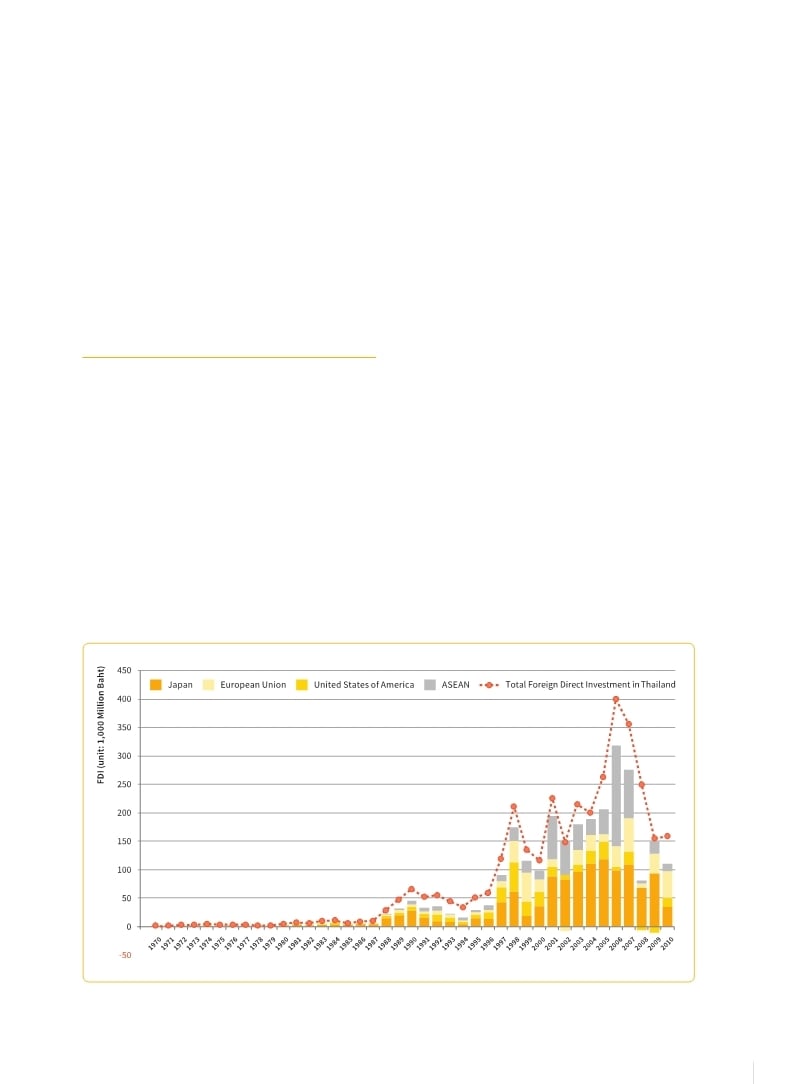
Thampanishvong, 2012 Thampanishvong, K. 2012.,The Case of Thailand., Background Paper prepared for the 2013 Global Assessment Report on Disaster Risk Reduction., Geneva,Switzerland: UNISDR.. Click here to view this GAR paper. Figure 14.4 Major sources of FDI into Thailand
|


 |