 |
Global Assessment Report on Disaster Risk Reduction 2013
From Shared Risk to Shared Value: the Business Case for Disaster Risk Reduction |
|
Global Assessment Report on Disaster Risk Reduction 2013
From Shared Risk to Shared Value: the Business Case for Disaster Risk Reduction |
|
|


|
82
Part I - Chapter 5
disasters (UNISDR, 2011
UNISDR. 2011.,Global Assessment Report on Disaster Risk Reduction: Revealing Risk, Redefining Development., United Nations International Strategy for Disaster Reduction., Geneva,Switzerland: UNISDR.. . Based on this analysis, the Colombian Government’s new disaster risk financing strategy will include risk transfer solutions for potentially affected infrastructure and low-income housing as well as a strong retention strategy via reserve funds (Government of Mexico and World Bank, 2012
Government of Mexico and World Bank. 2012.,Improving the Assessment of Disaster Risks to Strengthen Financial Resilience., A Special Joint G20 Publication by the Government of Mexico and World Bank. 2012 International Bank for Reconstruction and Development / International Development., Washington DC,USA. Available at https://www.gfdrr.org/G20DRM. The scale of a government’s fiscal deficit or financing gap following a disaster depends on how explicit and implicit the liabilities of governments are defined. The Government of Colombia, for example, has recognised this, and has embarked on an ambitious effort to fully assess contingent liabilities arising from disaster risk (see Chapter 15 of this report)—this initiative is part of its overall management strategy for government contingent liabilities (Government of Mexico and World Bank, 2012
Government of Mexico and World Bank. 2012.,Improving the Assessment of Disaster Risks to Strengthen Financial Resilience., A Special Joint G20 Publication by the Government of Mexico and World Bank. 2012 International Bank for Reconstruction and Development / International Development., Washington DC,USA. Available at https://www.gfdrr.org/G20DRM. Basing its analysis of liability on GAR11’s examination of Colombia’s probable maximum losses from
(Source: Mechler et al., 2009
Mechler, R., Hochrainer, S., Pflug, G., Lotsch, A. with Williges, K. 2009.,Assessing the Financial Vulnerability to Climate-Related Natural Hazards., Policy Research Working Paper, 5232 (Background Paper for the Development and Climate Change World Development Report 2010)., Washington, DC: World Bank.,. . (Source: UNISDR, adapted from CIMNE et al., 2013b)
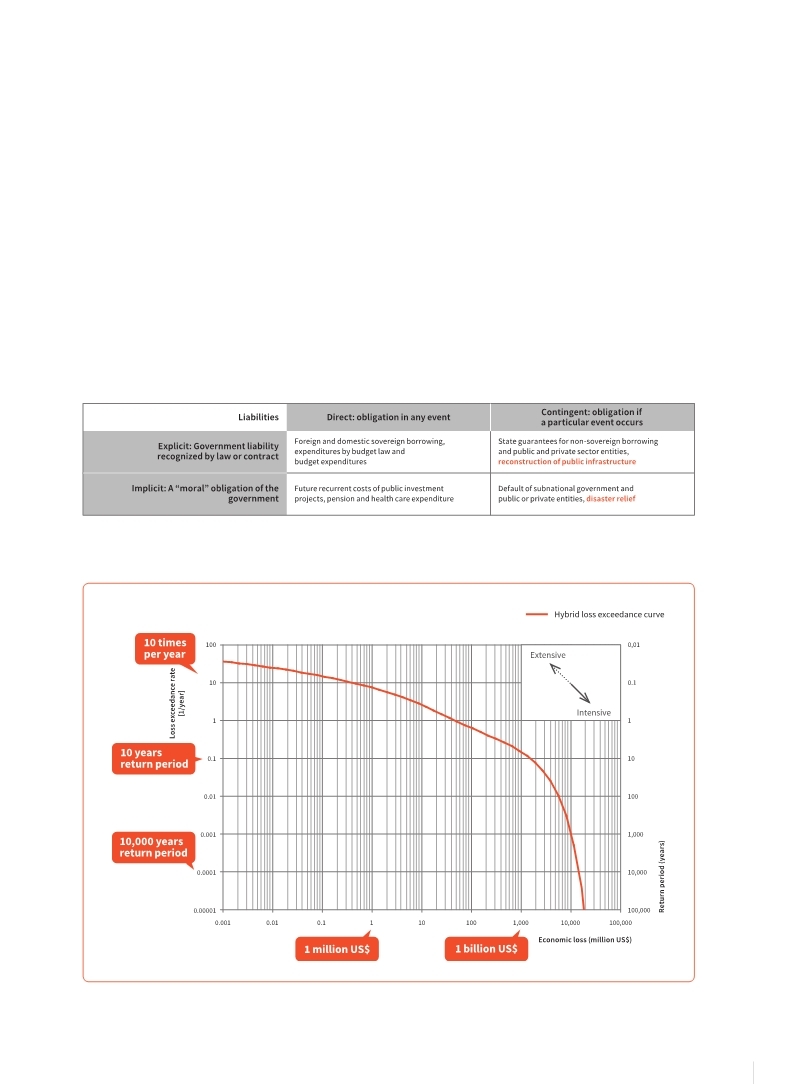
Table 5.2 Liabilities of a national government (items that can be related to risk from physical hazard appear in red)
Figure 5.4 Loss exceedance curve for Honduras
|


 |