 |
Global Assessment Report on Disaster Risk Reduction 2013
From Shared Risk to Shared Value: the Business Case for Disaster Risk Reduction |
|
Global Assessment Report on Disaster Risk Reduction 2013
From Shared Risk to Shared Value: the Business Case for Disaster Risk Reduction |
|
|


|
81
A first approach to resilience is to look at a country’s capacity to invest. Gross fixed capital formation (GFCF) is a metric that represents annual public and private investment in a country.i
Some countries that can least afford to lose investment are losing the most. For example, in Mozambique, the value of annual reported disaster losses surpassed GFCF three times during the period 1993– 2011. In each episode, investment not only slowed down in the country but actually reversed. In 2011, this value represented 12 percent of Mozambique’s capital formation, in El Salvador, 8 percent; and in both Honduras and Nicaragua, about 6 percent.
Figure 5.2 below highlights the proportion of GFCF at risk from both earthquakes and cyclonic winds. When annual average losses (AAL) represent a high proportion of GFCF, this implies that it will take longer for lost capital to be replaced by new investment and thus recovery slower.
For example, Japan not only has a high absolute AAL, this also represents a high proportion of its total GFCF. This means that losses cannot be easily replaced by the formation of new capital stock. In general, countries with sluggish growth and investment will find it more difficult to replace lost capital stock. In these countries, to protect economic growth, investment in disaster risk reduction is extremely important.
In contrast, countries such as the United States of America or China, which also have high absolute levels of AAL, have much higher rates of capital formation. This means that they will be able to replace lost capital more quickly and have a shorter recovery time.
A second approach to economic resilience is to estimate fiscal losses, which are disaster losses that governments are responsible for. As Box 5.1 shows, these losses can challenge the macroeconomic stability of even high-income countries. Macroeconomic stability is considered a basic requirement of a country’s competitiveness (WEF, 2012
WEF (World Economic Forum). 2012.,The Global Competitiveness Report 2012-2013., World Economic Forum., Geneva,Switzerland.. . therefore need to recognise the potential macroeconomic implications of disasters.
5.2
The financing gap
A country’s economic resilience depends to an important extent on whether a government is able to absorb losses. Assessing the fiscal capacity of a country is therefore critical to knowing whether it will be in the position to provide timely relief, invest in the required reconstruction and buffer economic downturns to avoid major and long-term macroeconomic impacts.
Economic resilience also depends on whether a government is able to finance recovery and reconstruction through a broad array of public and private mechanisms, including budget reallocations, tax increases, reserves, domestic or external borrowing, international assistance, insurance and reinsurance payouts, and market mechanisms such as catastrophe-linked securities (Mechler et al., 2006
Mechler, R., Linnerooth-Bayer, J., Hochrainer, S. and Pflug, G. 2006.,Assessing Financial Vulnerability and Coping Capacity: The IIASA CatSim Model. Concepts and Methods., In Measuring Vulnerability and Coping Capacity to Hazards of Natural Origin., J. Birkmann (ed.).,United Nations University Press, Tyo, 380-398.. . (Source: Government of Mexico and World Bank, 2012
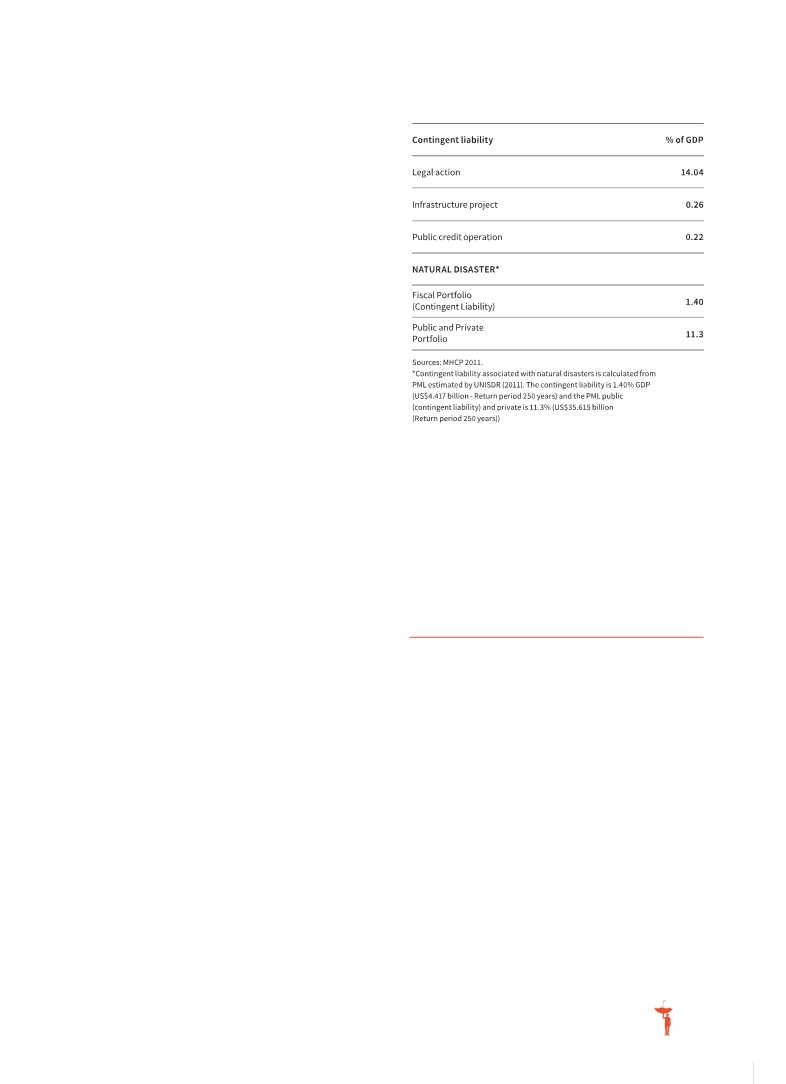
Government of Mexico and World Bank. 2012.,Improving the Assessment of Disaster Risks to Strengthen Financial Resilience., A Special Joint G20 Publication by the Government of Mexico and World Bank. 2012 International Bank for Reconstruction and Development / International Development., Washington DC,USA. Available at https://www.gfdrr.org/G20DRM. Table 5.1 Estimated contingent liabilities for the Government of Colombia
|


 |