 |
Global Assessment Report on Disaster Risk Reduction 2013
From Shared Risk to Shared Value: the Business Case for Disaster Risk Reduction |
|
Global Assessment Report on Disaster Risk Reduction 2013
From Shared Risk to Shared Value: the Business Case for Disaster Risk Reduction |
|
|


|
205
ance, which is again legally mandated to accompany natural peril coverage (
 Orie and Stahel, 2012 Orie and Stahel, 2012 Orie, M. and Stahel, W.R. 2012.,UNISDR Case Study Report., Background Paper prepared for the 2013 Global Assessment Report on Disaster Risk Reduction., Geneva,Switzerland: UNISDR.. Orie, M. and Stahel, W.R. 2012.,UNISDR Case Study Report., Background Paper prepared for the 2013 Global Assessment Report on Disaster Risk Reduction., Geneva,Switzerland: UNISDR.. Click here to view this GAR paper. Orie and Stahel, 2012 Orie, M. and Stahel, W.R. 2012.,UNISDR Case Study Report., Background Paper prepared for the 2013 Global Assessment Report on Disaster Risk Reduction., Geneva,Switzerland: UNISDR.. Click here to view this GAR paper. PPPs, as in the Norwegian case, can ensure high solvency, high penetration rates, and high amounts of accumulated capital reserves. They can also encourage risk-sensitive investment behaviour for businesses. However, care should be taken to maintain appropriate levels of competition among insurance companies, with the public sector focusing on facilitating and regulating the development of insurance markets based on sound risk assessments and
providing an enabling environment for investments in risk reduction. Moreover, it is in the interest of national governments to use strong partnerships with the insurance sector to bolster its own financial liquidity and ensure fiscal stability during major disasters (see Box 13.5 and Chapter 5 of this report).
13.2
Risk for sale:
insurance-linked securities
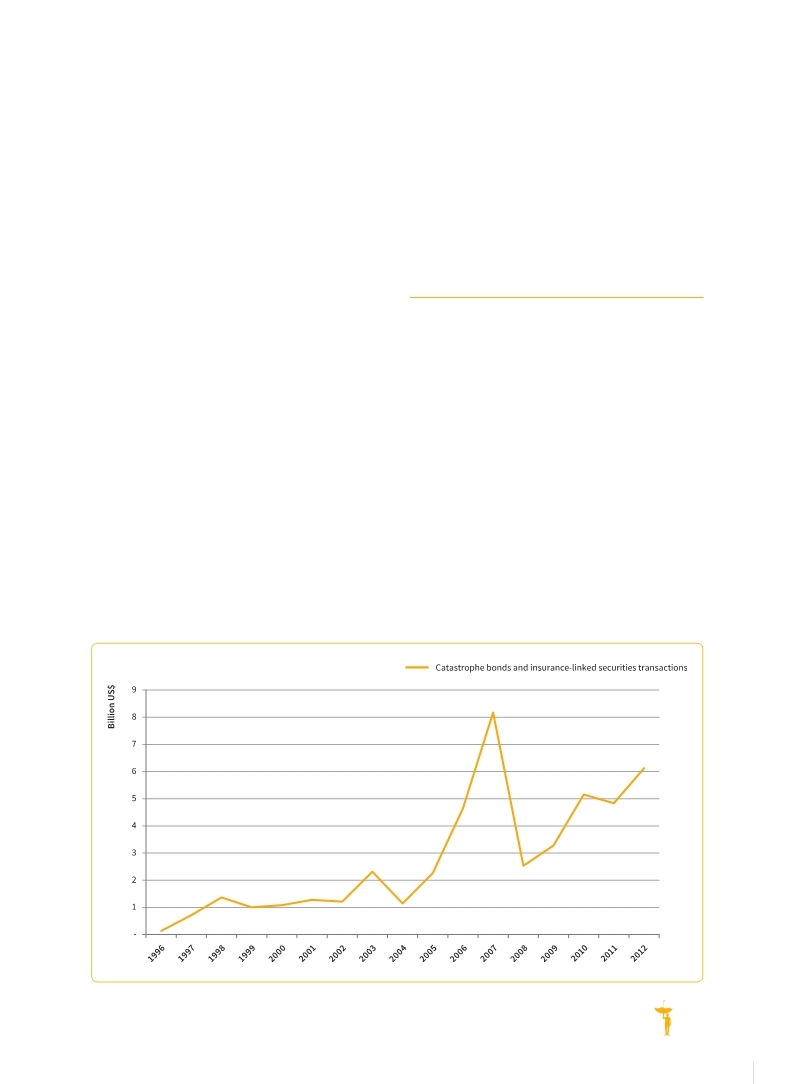
Financial markets are now increasing the supply of capital to the insurance industry through insurance-linked securities and similar financial products. This increases competition and the choice of insurance products available to manage disaster risks. However, these advantages may be undermined if asset managers and catastrophe bond issuers favour short-term gains in bond prices over the more sustainable long-term returns derived from potentially more realistic risk analysis.
The capital market around insurance and reinsurance has grown rapidly over recent years (Figure
Figure 13.1 Growth in the catastrophe bonds and insurance-linked securities market, 1996-2012
|


 |