1. Home
  2. Knowledge Base | PreventionWeb
  3. Themes

Disaster risk communication

This theme covers disaster risk communication, advocacy and awareness raising of disaster risk reduction (DRR) including through traditional and new media, as well as guidance for journalists reporting on disasters, guidance on communicating about climate change and extreme weather attribution. Raising awareness is a key disaster risk management activity.

Visit the Risk Media Hub: a toolkit for news media professionals reporting on disasters and resilience. he toolkit provides an array of resources to help journalists tell the other side of the disaster story and raise critical questions to help societies become more resilient.

Explore the Disaster Risk Communication Hub: the risk communication hub aims to support practitioners - from any sector - who are planning public risk communication strategies with the general public.

When crises strike, fear, uncertainty, and information overload make people more vulnerable to false narratives and disinformation.

Latest Disaster risk communication additions in the Knowledge Base

When the ocean comes inland: Tsunami preparedness policy for Pacific island and Hawaii coastal communities — What the warning systems missDocuments and publications
When the ocean comes inland: Tsunami preparedness policy for Pacific island and Hawaii coastal communities — What the warning systems miss
Island Security Policy Institute Hazard impact information has the greatest effect on how people respond to alertsResearch briefsWhy alerts need hazard impact informationThe Warn Room
Update
Geneva hosts first global UN event on risk communication

On this year’s International Day for Disaster Risk Reduction, UNDRR, UNESCO and IFRC explored how reliable information, resilient media and local knowledge help communities understand risks and prepare for disasters.

United Nations Educational, Scientific and Cultural Organization (UNESCO)
Resilience-building games
Update
IDDRR: Geneva students take disaster preparedness home

A hands-on experience of disaster risk reduction helps equip the next generation for a resilient future.

United Nations Office for Disaster Risk Reduction (UNDRR)
Powerful hurricane Melissa seen from space with a clearly defined eye over the Caribbean sea, Octoner 2025.
Research briefs
Hurricane graphics improve awareness, not risk perception

A study found that updated hurricane forecast graphics help people identify inland watch areas but don't improve risk perception or protective intentions, highlighting the need for clearer local impact information to support safety decisions.

Florida State University
HEAT: POST-PROJECT REFLECTION REPORT  thumbnail
Documents and publications

The Harmful Environmental Agendas and Tactics (HEAT) project examined climate-related misinformation and harmful narratives circulating across France, Germany, and the Netherlands.

EU DisinfoLab
Managing an infodemic in the global south: a systematic evidence synthesis from COVID-19 social listening reports thumbnail
Documents and publications

This study analyses COVID-19 misinformation in South Africa, highlighting how continuous social listening and community-based communication can inform more adaptive responses to public health misinformation.

Frontiers in Public Health
Update
The circular approach to good communication in a health crisis

This article addresses how social listening can improve health crisis communication, highlighting the need to identify public concerns, tailor responses and continuously assess changing information needs.

Conversation Media Group, the
Alpine hazards, cultural memory, and storytelling's relevance for collective  risk communication and disaster processing: A scoping review thumbnail
Documents and publications

This study examines how storytelling and cultural memory can strengthen risk communication in Alpine communities, helping translate hazard information into protective action, collective resilience and disaster recovery.

Progress in Disaster Science (Elsevier)
Associations between early warning message completeness, reception mode, and protective action across four at-risk communities in Ethiopia and South Africa thumbnail
Documents and publications

This study examines early warning messages in Ethiopia and South Africa, finding that direct recipients reported more complete warnings and were more likely to take protective action than those receiving information indirectly.

International Journal of Disaster Risk Science
Talking risk, enacting resilience: a case study of risk communication in a climate frontline community thumbnail
Documents and publications

This study examines community-based climate risk communication in California, showing how locally driven information exchange can strengthen trust, collective action and resilience to multiple hazards.

Natural Hazards (Springer)
Update
Japan’s mega-quake that never was, and the danger of false alarms

A software error triggering a false magnitude 9.9 quake in Japan sparks fears that eroding public trust could cost lives in a real quake

South China Morning Post
The Paradoxes of Climate Change Reporting: A study of landslide news coverage in Hindi language newspapers of Himachal Pradesh, India thumbnail
Documents and publications

The study looks into the existing gaps in the newsrooms of the selected editions of the Hindi-language newspapers reporting on the issues of climate change.

Journal of Development Communication
Update
When El Niño hits home

Households absorb much of the cost of disasters: Post-Disaster Needs Assessments from 20 countries in Asia and the Pacific put about 40 per cent of impacts in social and productive sectors. ESCAP sets out three government interventions.

United Nations Economic and Social Commission for Asia and the Pacific (UN-ESCAP)
Update
Podcast: Counter Crisis Season 3

Third season of Counter Crisis bridges the distance people closest to a disaster and decision makers about the money to respond. In each episode, the policymakers and the people living with their decisions are in the same conversation for the first time.

Centre for Disaster Protection
Update
Romanians’ earthquake preparedness gap

A survey by IRES for the Romanian insurers’ association UNSAR finds that 88 per cent of Romanians say they know how to react in an earthquake, but only 44 per cent have agreed a family plan and 40 per cent keep a first-aid kit.

Romania Journal
Update
Mosque loudspeakers as quake alarms

The Indonesian government is working with Japan to broadcast earthquake early warnings through mosque loudspeakers, with trials planned in Jakarta and other regions by 2030 before nationwide rollout.

Guardian, the (UK)
Meetings and conferences
Online
Aligned with the UNDRR's IDDRR 2026 global theme, “Resilience Starts at Home,” this event will connect the urgent need for safer homes and resilient communities with emerging opportunities for young professionals, researchers and aspiring entrepreneurs.
Launch ceremony of the inclusive early warning initiative in Lao PDR
Update
Lao PDR launches competition to make early warnings reach everyone

The Government of Lao PDR, supported by the United Nations, NGOs and CSOs, launch an inclusive risk communication initiative and a video competition on the International Day for Disaster Risk Reduction to improve early warnings.

United Nations Office for Disaster Risk Reduction - Regional Office for Asia and Pacific
Lao People's Democratic Republic - government
Meetings and conferences
Online
The IAVCEI ECR-Net and the EGU Working Group on Geoethics host an online panel on the ethical challenges of volcanic disaster risk management – decision-making under uncertainty, risk communication and engagement with affected communities.
Accessibility and resource use in crisis and emergency risk communication and risk reduction: The self-reinforcing responsive model (SRRM) thumbnail
Documents and publications

This study examines how Canadian emergency management organizations conceptualize and implement accessible risk communication

International Journal of Disaster Risk Reduction (Elsevier)
Meetings and conferences
Vientiane
In person
The Government of Lao PDR supported by UNDRR, the UN Resident Coordinator's Office and the UN Communication Group launch an inclusive risk communication initiative and an open call for short videos on inclusive multi-hazard early warnings.
Smartphone displaying a flash flood warning alert screen, held by a person standing near rising floodwaters. Concept for emergency notification, natural disaster preparedness, and weather alerts
Pramod Dabrase
This blog's author suggests moving from early warning to early action requires connecting authoritative risk intelligence with people's current location, capabilities and ability to act.
Update
Bangladesh: Govt steps up disaster preparedness with weather app

The application, named “Abhawa”, is designed to provide the public with easier access to official weather information and forecasts.

Daily Star, the - Bangladesh
Update
Game helps players learn about climate impacts on tribal communities

Inspired by the Menominee Tribe and Reservation in Wisconsin, the game tasks players with responding to floods, fires, droughts, and other extreme weather events.

Yale Climate Connections
 Heat early warning system in Bangladesh: Current status and recommendations thumbnail
Documents and publications

This case study examines the current status of Bangladesh’s heat early warning system, outlining how heat risk is understood, monitored, and communicated, and how warnings prompt actions across institutions.

International Federation of Red Cross and Red Crescent Societies (IFRC)
Concept of colourful speech bubbles
Last updated 6 Oct 2026
Risk communication is critical to help the public understand the different types of risks they face, discuss what can be done and take action to manage those risks.
Update
Post-alert messages should confirm safety first

Research on post-alert messaging finds that after a false alert people need two things: assurance the threat is over, and a plain statement that they are safe. Attribution comes later.

The Warn Room
Meetings and conferences
Ancona, Marche
In person
The High-Performance Computing for Disaster Resilience (HPC4DR) consortium, in collaboration with the Polytechnic University of Marche, is organizing a public meeting as part of the 2026 International Day for Disaster Risk Reduction.
Earthquake risk in Accra, Ghana: Household perceptions, awareness, and preparedness in a rapidly urbanising metropolis thumbnail
Documents and publications

This study examines household earthquake risk awareness and preparedness in Ghana’s Greater Accra Metropolitan Area, revealing high awareness but low preparedness. Education and prior tremor experience significantly predict readiness.

International Journal of Disaster Studies and Climate Resilience (IJDSCR)
How to communicate and educate more effectively on natural risk issues to improve disaster risk management through serious games thumbnail
Documents and publications

This study examines how serious games can support disaster risk management education, identifying design features that improve risk communication, learning and preparedness.

University of Granada
COMMUNICATING CLIMATE RISK A TOOLKIT thumbnail
Documents and publications

The Toolkit seeks to narrow the gap between climate science and climate action by providing insights, recommendations, and practical tools to support dialogue between scientists, decision-makers, and many diverse communities.

University of Sussex
Research briefs
Climate disinformation: what EU policymakers need to know and do

This primer offers actionable guidance for EU policymakers to combat climate disinformation – an issue they are increasingly confronted with and that can seriously impede their work.

New Climate Institute for Climate Policy and Global Sustainability
Update
Conspiracy theories blame Colombia earthquake on research program

This fact check debunks claims that High-frequency Active Auroral Research Program caused Colombia’s deadly earthquake, explaining that the disaster resulted from natural fault movement, not human activity or radio-frequency technology.

Los Angeles Times
Barriers and best practices for inclusive emergency alerts and warnings thumbnail
Documents and publications

This article reviews barriers to inclusive emergency alerts, highlighting how limited language access, inaccessible channels and mistrust can prevent people from receiving and acting on warnings.

International Journal of Disaster Risk Reduction (Elsevier)
The value of journalism: global evidence on why media matters to economies, national security and crises thumbnail
Documents and publications

The chapter 4 "National security and stability" examines how journalism can reduce the harms of disinformation, showing how trusted news, fact-checking and media freedom support public resilience, security and stability.

United Nations Educational, Scientific and Cultural Organization (UNESCO)
A universal taxonomy for natural hazard and climate risk and resilience assessments – Infrastructure edition thumbnail
Documents and publications

A framework providing a universal taxonomy for natural hazard and climate risk and resilience assessments of infrastructure systems, defining Risk Classes, Resilience Classes and guidance for hazard, climate and infrastructure assessments.

Arup International Development
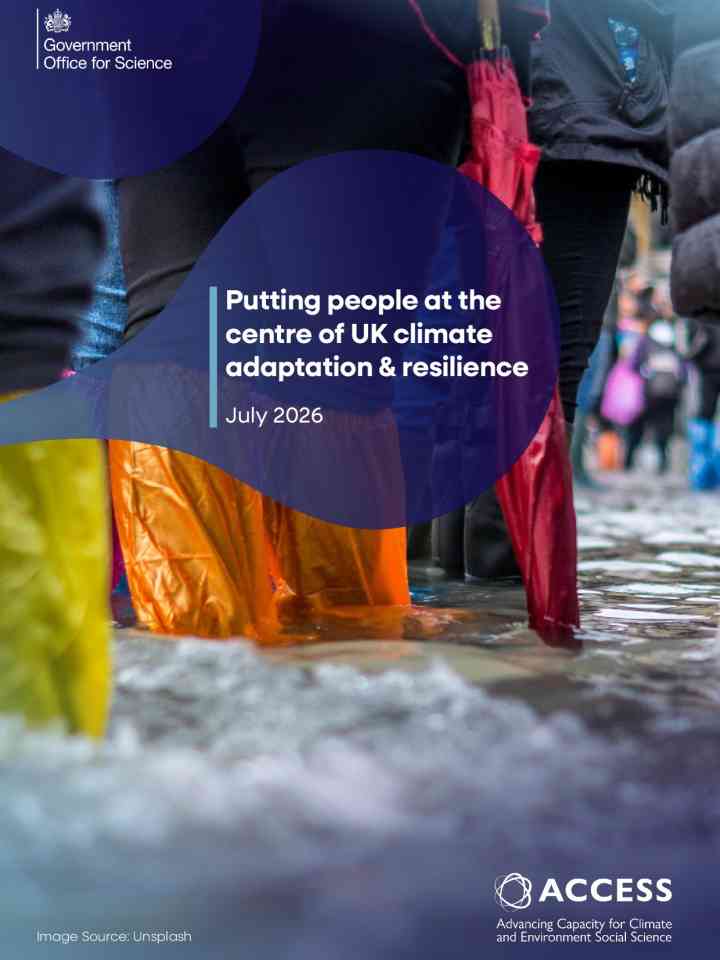
Putting people at the centre of UK climate adaptation & resilience thumbnail
Documents and publications

This report synthesises social science evidence on climate adaptation and resilience for UK policymakers, highlighting adaptation as an ongoing social process shaped by people’s lived experiences, vulnerabilities, and social context.

Government Office for Science
Advancing Capacity for Climate and Environment Social Science
A striking landscape depicting a drought-stricken lake surrounded by mountain peaks.
Update
‘Super’ or ‘Godzilla,’ El Niño is already breaking records

The article explores the record-strength 2026 El Niño, its global impacts and links to climate change, while examining how terms such as “super El Niño” shape how scientists, media and the public understand extreme events.

Grist Magazine
Unpacking the practices of compound hazard communication Unpacking the practices of compound hazard communicatio thumbnail
Documents and publications

This study examines communication for compound natural hazards in Australia, showing how listening, disaster literacy and creativity can support preparedness, response and recovery

International Journal of Disaster Risk Reduction (Elsevier)
Putting people at the centre of UK climate adaptation & resilience thumbnail
Documents and publications

This report synthesizes social science evidence on UK climate adaptation, showing how people-centered approaches can make resilience policy more effective, equitable and responsive to lived experience.

United Kingdom - government
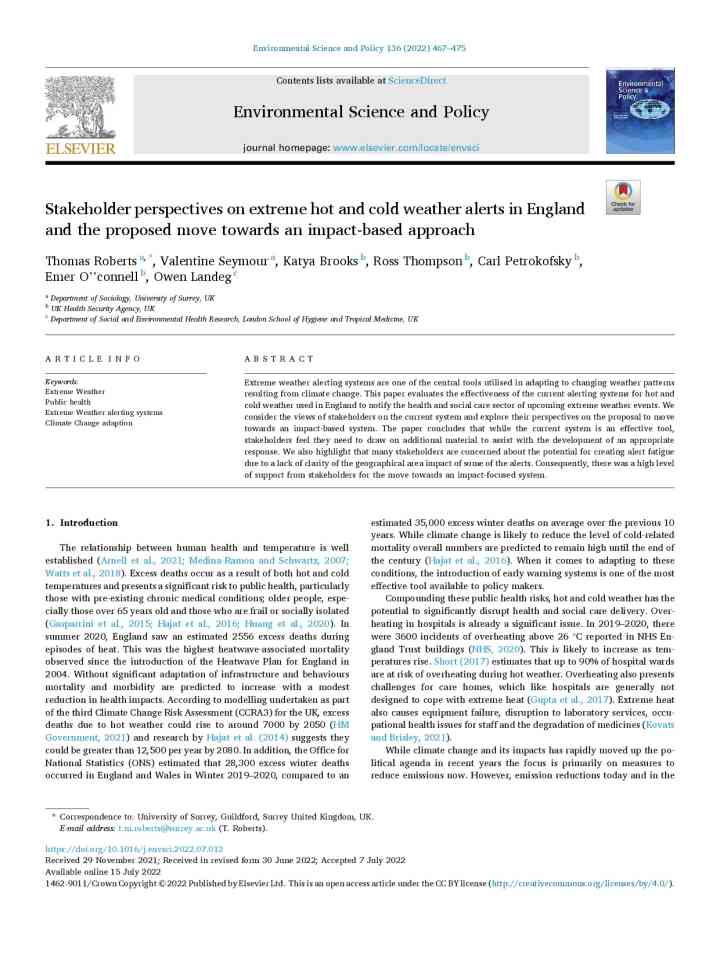
Stakeholder perspectives on extreme hot and cold weather alerts in England and the proposed move towards an impact-based approach thumbnail
Documents and publications

This paper evaluates the effectiveness of the current alerting systems for hot and cold weather used in England to notify the health and social care sector of upcoming extreme weather events.

Environmental Science and Policy (Elsevier)
Training event
-
In person
This is a joint winter school organized and hosted by the University of Twente and of the Vrije Universiteit Amsterdam.
Research briefs
Who do you trust in emergency? We asked people hit by extreme weather

This article shows that it is vital to focus on who delivers the early warning messages. Messengers commanding high levels of trust need to be actively engaged to ensure information reaches people frequently and widely.

Conversation Media Group, the
Awareness, education and communication  for compound natural hazards  thumbnail
Documents and publications

This report examines communication and engagement for compound natural hazards in Australia, highlighting the need for two-way, locally grounded approaches to strengthen preparedness and resilience.

Natural Hazards Research Australia
Update
The Alerting Authority Podcast: The seconds that could save your life

Jeannette Sutton and Eddie Bertola break down USGS ShakeAlert, earthquake early warnings, Wireless Emergency Alerts, and the technology that can warn people before strong shaking arrives.

The Alerting Authority
Breathtaking view of Mendenhall Glacier in Juneau, reflecting serene natural beauty.
Update
USA: Juneau can’t stop floods, but it’s learning to see them coming

Recurrent floods have forced Juneau to confront a problem that communities around the world are increasingly facing: How do you prepare for a natural disaster when you know it will come back?

Grist Magazine
Meetings and conferences
Geneva
Online
The event will identify practical approaches for strengthening risk communication as part of disaster preparedness and risk governance.
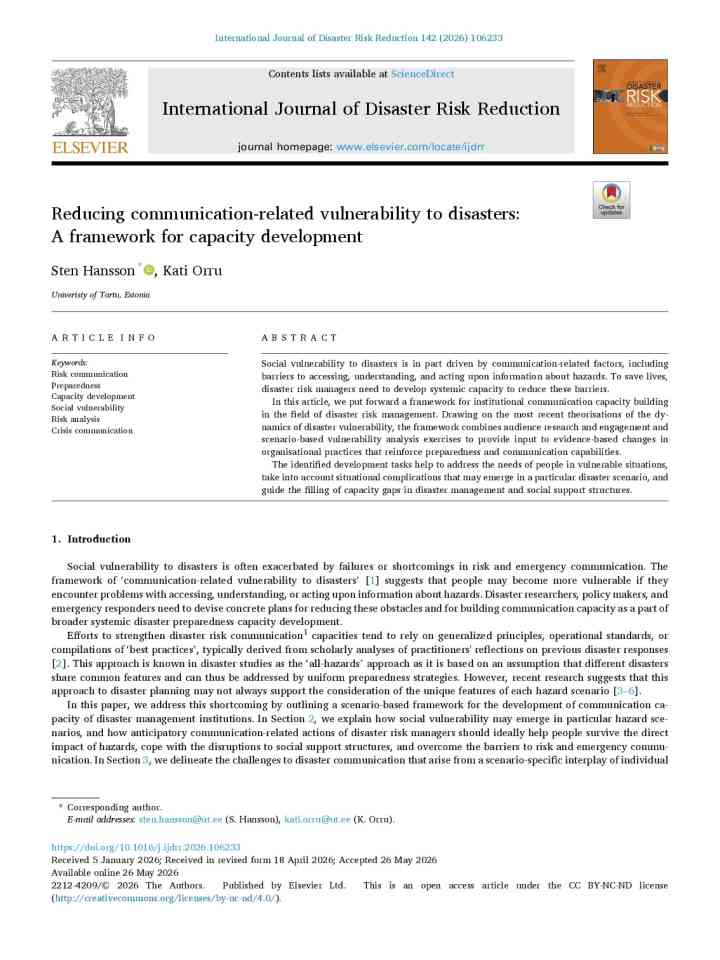
Reducing communication-related vulnerability to disasters: A framework for capacity development thumbnail
Documents and publications

This paper presents a framework for disaster communication capacity development that combines audience research, engagement and scenario-based vulnerability analysis to address barriers to accessing, understanding and acting on hazard information.

International Journal of Disaster Risk Reduction (Elsevier)
Reimagining disaster risk assessment: The role of information equity in vulnerable communities thumbnail
Documents and publications

This study advances an equity-centered approach by centering informational equity as an underexamined dimension of disaster vulnerability. Findings show informational inequities emerge from systematic misalignments across the risk communication ecosystem.

International Journal of Disaster Risk Reduction (Elsevier)