 |
Global Assessment Report on Disaster Risk Reduction 2013
From Shared Risk to Shared Value: the Business Case for Disaster Risk Reduction |
|
Global Assessment Report on Disaster Risk Reduction 2013
From Shared Risk to Shared Value: the Business Case for Disaster Risk Reduction |
|
|


|
84
Part I - Chapter 5
optimistic scenarios of resource availability; other scenarios showed that the Government of Madagascar would be challenged to cover losses from even annual events (Ibid.).
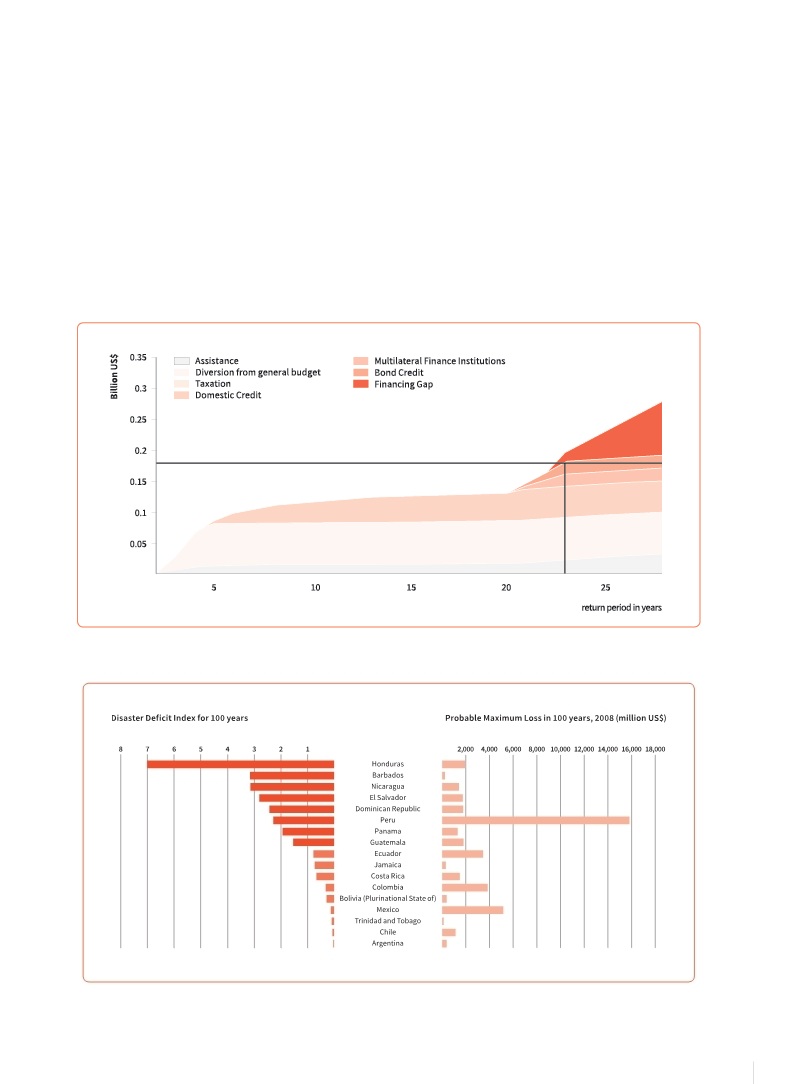
This information is useful in two ways. First, it indicates what scale of disaster would exhaust and exceed a country’s domestic resources (taxes and budget diversion) and external resources (largely
new debt). Second, based on the analysis of impacts from disasters for selected return periods, such as a one-in-100 year event, information on the monetary scale of resources and gaps can be used to develop risk financing instruments and negotiate appropriate premiums.
The Inter-American Development Bank’s disaster deficit index (DDI) highlights resource implications
(Source: Hochrainer, 2012
Hochrainer, S. 2012.,Financial and Economic Disaster Risk Estimation in Madagascar for the Implementation of CatSim., Summary report for the project "Mainstreaming Disaster Risk Management and Climate Change in Economic Development. Technical Assistance to the Republic of Madagascar"., IIASA,. . (Source: UNISDR, based on IADB, 2010
IADB (Inter-American Development Bank). 2010.,Indicators of Disaster Risk and Risk Management. Program for Latin America and the Caribean., Technical notes, IDB-TN-169, September 2010.. .  ERN-AL, 2011 ERN-AL, 2011 ERN-AL (Consortium Evaluación de Riesgos Naturales – America Latina). 2011.,Probabilistic modelling of disaster risk at global level: development of a methodology and implementation of case studies. Phase 1A: Colombia, Mexico and Nepal., Background Paper prepared for the 2011 Global Assessment Report on Disaster Risk Reduction., Geneva,Switzerland. ERN-AL (Consortium Evaluación de Riesgos Naturales – America Latina). 2011.,Probabilistic modelling of disaster risk at global level: development of a methodology and implementation of case studies. Phase 1A: Colombia, Mexico and Nepal., Background Paper prepared for the 2011 Global Assessment Report on Disaster Risk Reduction., Geneva,Switzerland. Click here to view this GAR paper. Figure 5.6 The fiscal gap for cyclone exposure in Madagascar
Figure 5.7 Countries’ ability to absorb the losses of a one-in-100 year event (2008 data)
|


 |