 |
Global Assessment Report on Disaster Risk Reduction 2013
From Shared Risk to Shared Value: the Business Case for Disaster Risk Reduction |
|
Global Assessment Report on Disaster Risk Reduction 2013
From Shared Risk to Shared Value: the Business Case for Disaster Risk Reduction |
|
|


|
171
seeds and the creation of monopolistic dependence. This is despite growing recognition that in future, new developments in biotechnology for plant breeding to address the challenges of an increasingly changing climate will be required.
The 2008 World Development Report on Agriculture reported strong synergies between agribusiness, agriculture performance and poverty alleviation (World Bank, 2008b
World Bank. 2008b.,World Development Report 2008: Agriculture for Development., Washington DC: World Bank,. . Agribusiness companies usually seek to do this via a combination of partnerships to increase opportunities for technology transfer, contract farming and hybrid schemes of small and large-scale farming.
Many of the elements in this approach are already well known and have been successfully demonstrated to produce results: agro-ecological approaches to agriculture, which can increase productivity, strengthen resilience and conserve natural capital (Pretty, 2006
Pretty, J. 2006.,Agro-ecological approaches to agricultural development., Background Paper for the World Development Report 2008. Rimisp-Latin American Center for Rural Development contribution to 2008 WDR.. . Altieri, M.A. 1987. ,Agroecology: the scientific basis of alternative agriculture., Boulder: Westview Press.,. . Sekar, N.U. 2000.,Decentralized Natural Resource Management: From State to Co-management in India., Journal of Environmental Planning and Management, 43(1), 123-138.. . Box 10.5 Agribusiness investing in smallholders
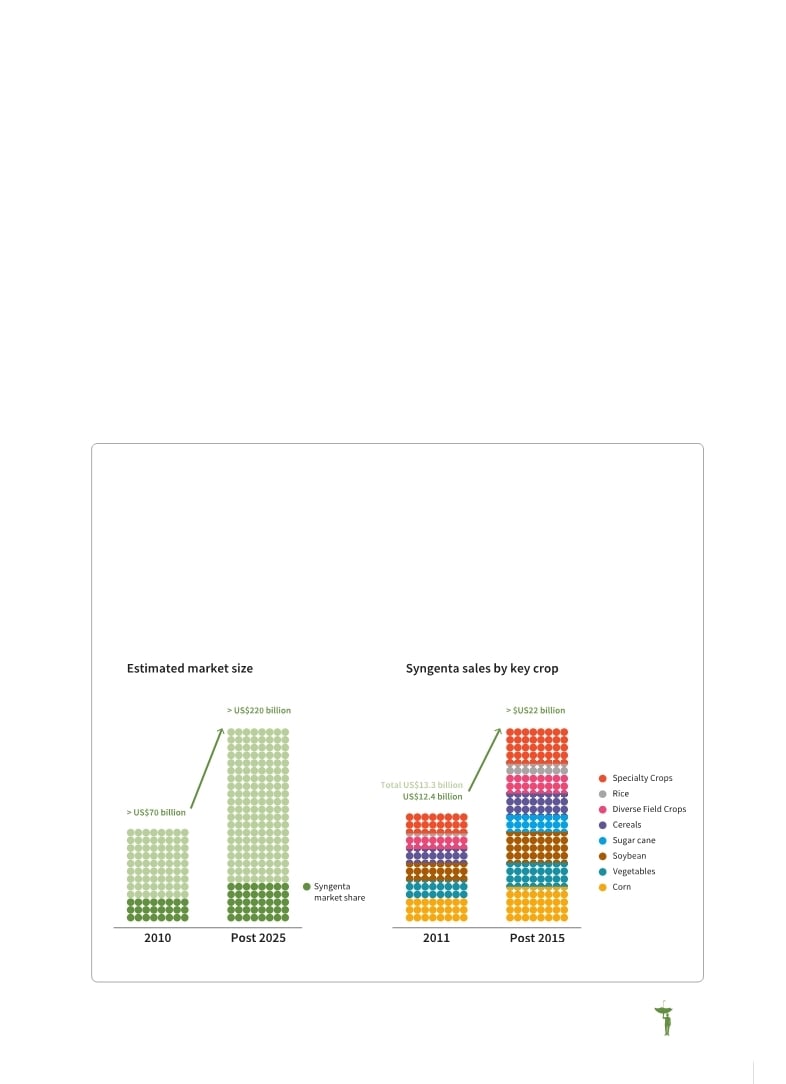
Syngenta —a world leader in crop protection—recognises the productive regions of sub-Sahara as a market that is vast and virtually untapped. In 2012, its CEO announced plans for a significant investment in smallholders across Africa.xiv More than 75 percent of maize production is currently provided by small farmers in the region (FAO, 2011 FAO (Food and Agriculture Organization), IFAD (International Fund for Agricultural Development), IMF (International Monetary Fund), OECD (Organisation for Economic Cooperation and Development), et. al. 2011.,Price Volatility in Food and Agricultural Markets: Policy Responses., Policy Report including contributions by FAO, IFAD, IMF,OECD, UNCTAD, WFP, World Bank, the WTO, IFPRI and the UN HLTF, 2 June 2011.. . FAO (Food and Agriculture Organization). 2011b.,Situation analysis: improving food safety in the maize value chain in Kenya., Report prepared for FAO by Prof. Erastus Kang'ethe, College of Agriculture and Veterinary Science., Nairobi,Kenya. . Figure 10.18 Syngenta estimated global market size and crop sales
(Source: Syngenta)
|


 |