 |
Global Assessment Report on Disaster Risk Reduction 2013
From Shared Risk to Shared Value: the Business Case for Disaster Risk Reduction |
|
Global Assessment Report on Disaster Risk Reduction 2013
From Shared Risk to Shared Value: the Business Case for Disaster Risk Reduction |
|
|


|
112 Part I - Chapter 7
(Source: Hsiang and Jina, 2012
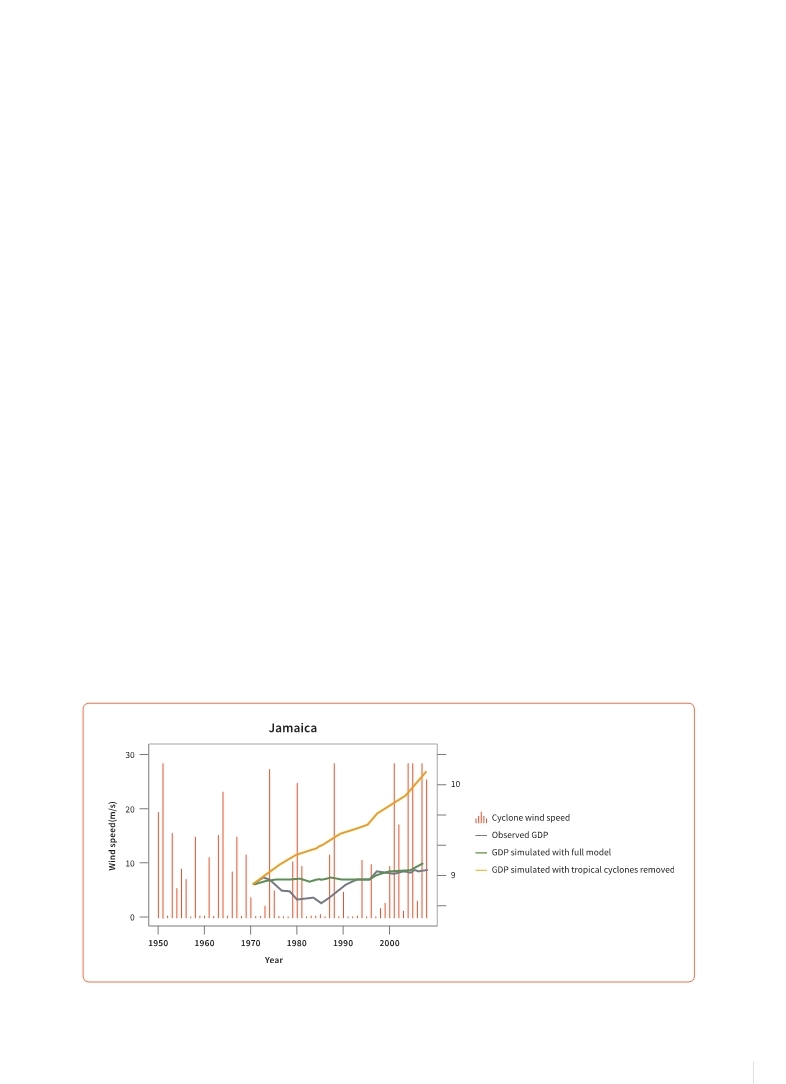
Hsiang, S.M. and Jina, A.S. 2012.,Development after Disaster., Background Paper prepared for the 2013 Global Assessment Report on Disaster Risk Reduction., Geneva,Switzerland: UNISDR.. . Figure 7.6 Impact of tropical cyclones on GDP growth in Jamaica
their small size, which means that hazard events may affect their entire territory and economy, because their economies are often concentrated in one or two sectors, and because many countries also have high levels of indebtedness and hence constrained fiscal space to invest. Additional common challenges include remoteness, narrow resource base, degradation of their marine and terrestrial environment and exposure to global environmental challenges, including climate change (UNDESA, 2010
UNDESA (United Nations Department of Economic and Social Affairs). 2010.,Trends in Sustainable Development. Small Islands Developing States (SIDS)., United Nations publication., New York,USA.. . With small and undiversified economies, many SIDS are severely constrained to participate successfully in the global economy. Geographic distance, lower trade and transport volumes and weak infrastructure generally mean that SIDS have higher overall logistics and transport costs—undermining their competitiveness. In the case of Jamaica (Figure 7.6), for example, the impact of repeated tropical cyclones may have contributed to sluggish growth over decades.
These challenges also present opportunities, however. Regional initiatives such as the Caribbean Catastrophe Risk Insurance Facility (CCRIF) and more
recently the PCRAFI (see Box 7.1) are facilitating greater awareness of the fiscal risk posed by disasters in the Caribbean and Pacific Island SIDS; they are also providing options for countries to reduce their financing gap. To be effective and sustainable in the medium term, these programmes need to be accompanied by commensurate investments to reduce disaster risks. In providing comprehensive risk assessments, they are also providing tools to do so.
On their own, it would be difficult for many SIDS to address their high levels of disaster risk, low levels of economic resilience and challenged competitiveness and sustainability. As the PCRAFI highlights, through effective regional mechanisms, the critical mass of technical and financial resources to reduce disaster risk becomes more readily available.
If these resources can be mobilised, then the biggest challenge for SIDS can also be their best opportunity. From one perspective, disaster risk presents a serious threat to these countries’ economic competitiveness. However, precisely because of this combination of high risks and low resilience, SIDS are probably the countries where investments in disaster risk reduction and climate change adaptation are likely to reap the greatest benefits. Investing in disaster risk reduction is most likely the best chance
|


 |