1. Home
  2. Knowledge Base | PreventionWeb
  3. Themes

Inclusion

Ensuring an all-of-society engagement and partnership for DRR through empowerment and inclusive, accessible and non-discriminatory participation, paying special attention to people disproportionately affected by disasters, especially the poorest.
Here are five ways countries ensure persons with disabilities are not left behind when the next disaster strikes.

Latest Inclusion additions in the Knowledge Base

Uploaded on
Documents and publications

This study examines the climate change and urban health vulnerability of suburban Pralab, Khon Kaen City, in the northeast of Thailand. One of the principal findings of the paper is that the urbanisation of Khon Kaen has led to profound physical and socio

International Institute for Environment and Development (IIED)
Rockefeller Foundation, the
Asian Cities Climate Change Resilience Network
Documents and publications

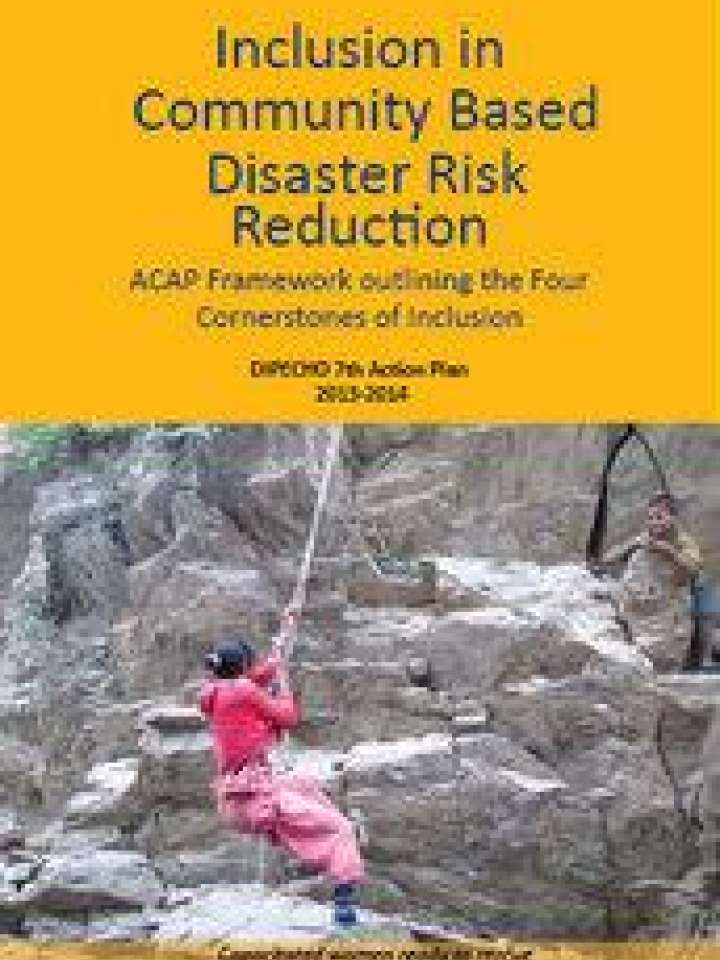
This brochure summarises the ACAP approach (Accessibility, Communication, Attitude, Participation), successfully applied to support Inclusive Community-Based DRR programming in Nepal.

The main idea behind this framework is to achieve “inclusion for all”

European Commission’s Directorate-General for European Civil Protection and Humanitarian Aid Operations (DG ECHO)
Mission East
Documents and publications

This paper charts the institutions and actors in the climate change adaptation (CCA) space in rural and urban semi-arid India and finds that development and adaptation span a continuum in policy and practice. The publication interrogates policies

International Development Research Center
University of Cape Town (UCT)
Indian Institute for Human Settlements, the
Documents and publications

This guide provides information on preparing an emergency plan and kit for people with disabilities/special needs and for caregivers. The publication acknowledges that while disasters and emergencies affect everyone, their impact on people with

Government of Canada
Update

National displacement from sea level rise is projected to reach 13 million people by 2100. Yet attempts at long-term solutions have been regressive - the National Disaster Resilience Competition risks replicating existing structures of social inequity by forcing communities to compete to access water, food and shelter, thereby refusing to recognize these as human rights.

Next City
Update

In the coming decades, heat waves will be longer, more frequent and more intense. Those most at risk are often the more vulnerable people who live in cities. As they work to adapt to more frequent or intense heat waves, US city leaders and emergency responders across the country are trying to figure out not only how to keep people safe, but how to cool their urban cores.

Environment & Energy Publishing
Update

“Stop Disasters” is a UNISDR disaster simulation game for children, who are asked to plan a safe environment - an often overlooked role for this population. The aim of introducing disaster risk reduction and climate friendly curriculum is not only to train children, but also to introduce behavior change in next generations to act responsibly and environmentally friendly.

Pakistan Today
Update

In step with many international aid agencies, the United Methodist Committee on Relief is putting significant effort into disaster risk reduction, even as it pursues its mission of alleviating suffering caused by disasters. The agency recently supported a three-day in-depth training in three vulnerable areas, aimed at ensuring a hazard does not become a deadly disaster.

United Methodist Committee on Relief
Uploaded on